10% Thanksgiving Promo! Promocode: THANKSGIVING

Benjamin’s Expert Guide to Fancy Green Diamonds

This guide explains what makes green diamonds rare, how they are graded, and what they cost. Buyers who focus on carat weight or clarity can overpay if they overlook what matters most in a green diamond: the quality and origin of its color.
Benjamin Khordipour, G.D., C.G.P., is a leading specialist in fancy-color diamonds and investment-grade estate jewelry. He trained at the Gemological Institute of America (GIA) in New York and at Gübelin in Switzerland before joining Estate Diamond Jewelry in 2014. His work focuses on rare diamonds, colored gemstones, and antique jewelry. He co-authored The Engagement Ring Guide for Men, and his commentary on the antique jewelry market is featured all across the media.
What Makes a Green Diamond Green?
One of the principal causes of natural green color is exposure to radiation during a diamond’s geological history. That exposure can displace carbon atoms from their usual positions in the crystal lattice. The resulting defects change which wavelengths of light the diamond absorbs, sometimes producing a green appearance. GIA researchers have also documented green luminescence associated with a defect called H3, as well as green colors linked to hydrogen- and nickel-related defects.
Natural radiation can leave a shallow green layer or scattered surface stains on a rough diamond. Faceting may remove much of this color, so a piece of rough with a distinctly green exterior can yield a polished stone with little visible green. In some cases, a cutter preserves a small area of the original rough near the girdle, the outer edge of the diamond. These characteristics help explain the scarcity of polished stones with strong face-up color.
Expert Breakdown: Green Diamond Colors and Grades
A GIA report for a 1.00-carat shield-cut diamond records Fancy Yellowish Green as the color grade, Natural as the color origin, and Even as the distribution. These entries describe three distinctly different characteristics of the same diamond. Together they provide a basis for interpreting its appearance and comparing it with other stones. GIA report for the 1.00-carat shield
1. Hue, Tone, and Saturation
Hue is the perceived color. Tone describes its relative lightness or darkness, and saturation describes its strength. A dark olive-green diamond, for example, may have a darker tone and weaker saturation than a lighter, more vivid green. GIA grades fancy-color diamonds face-up, viewing the stones from above under controlled conditions. The same orientation gives buyers a practical starting point for judging how the color will appear in a ring at normal viewing distance.
2. Green Diamond Intensity Grades
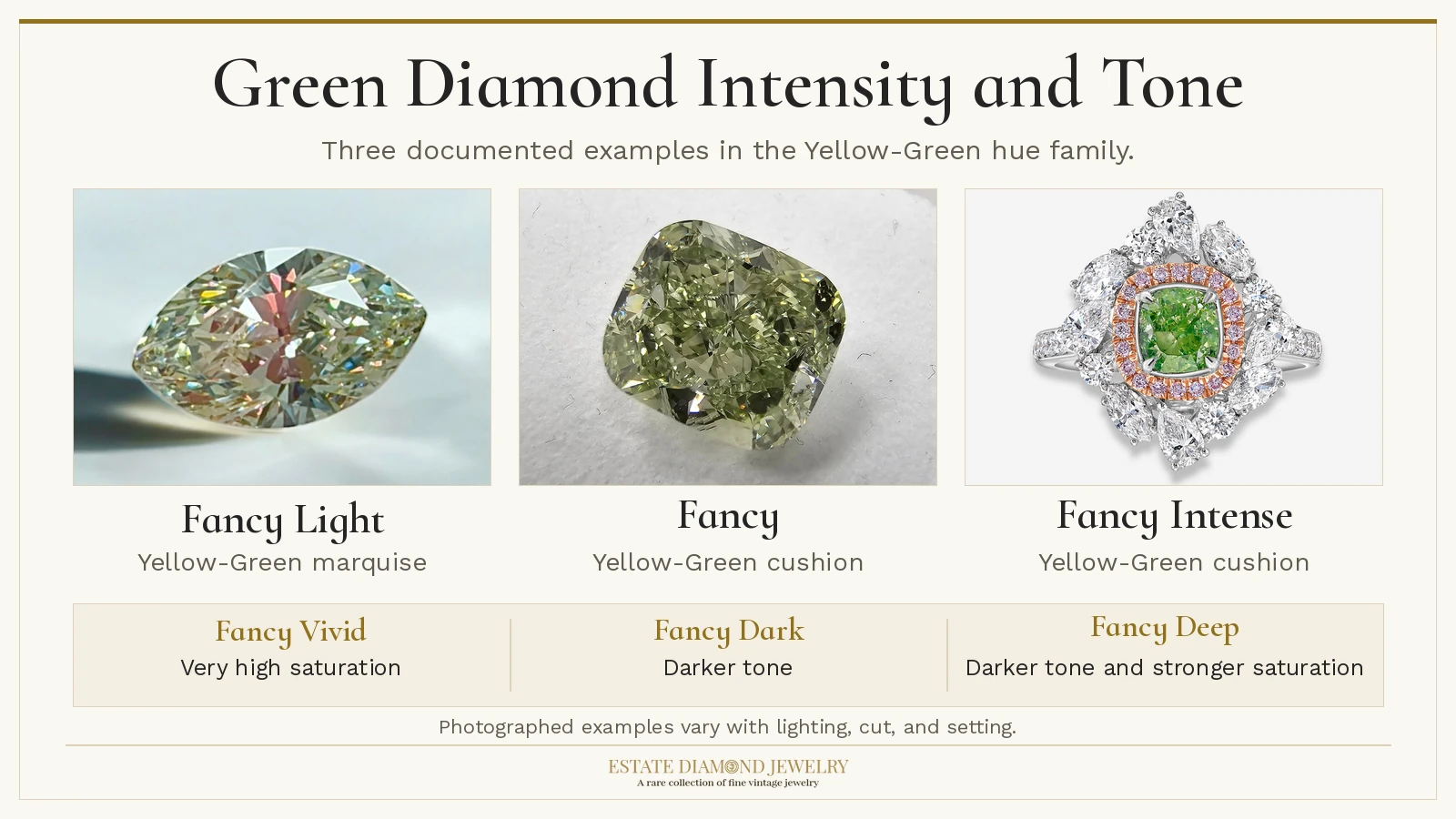
GIA uses Faint, Very Light, and Light for subtle color appearances. Fancy Light, Fancy, Fancy Intense, and Fancy Vivid are particularly relevant when comparing stones being offered for their visible green. A Fancy Light diamond can display a soft but distinct hue, while Fancy Intense and Fancy Vivid are useful starting points for buyers who prioritize saturation. A well-cut Fancy Green can offer clearly visible color at a lower price than a more intensely colored stone with otherwise comparable characteristics.
Fancy Dark and Fancy Deep occupy parts of the grading scale where darker tone plays a greater role. Fancy Deep combines a medium to dark tone with moderate to high saturation. Fancy Vivid combines a light to medium tone with very high saturation. These distinctions matter in ordinary lighting. A deeply toned diamond may show attractive green under strong display lighting and appear substantially darker under diffuse light. Examining both conditions helps establish how the stated grade translates into everyday appearance.
3. Color Modifiers and the Dominant Hue
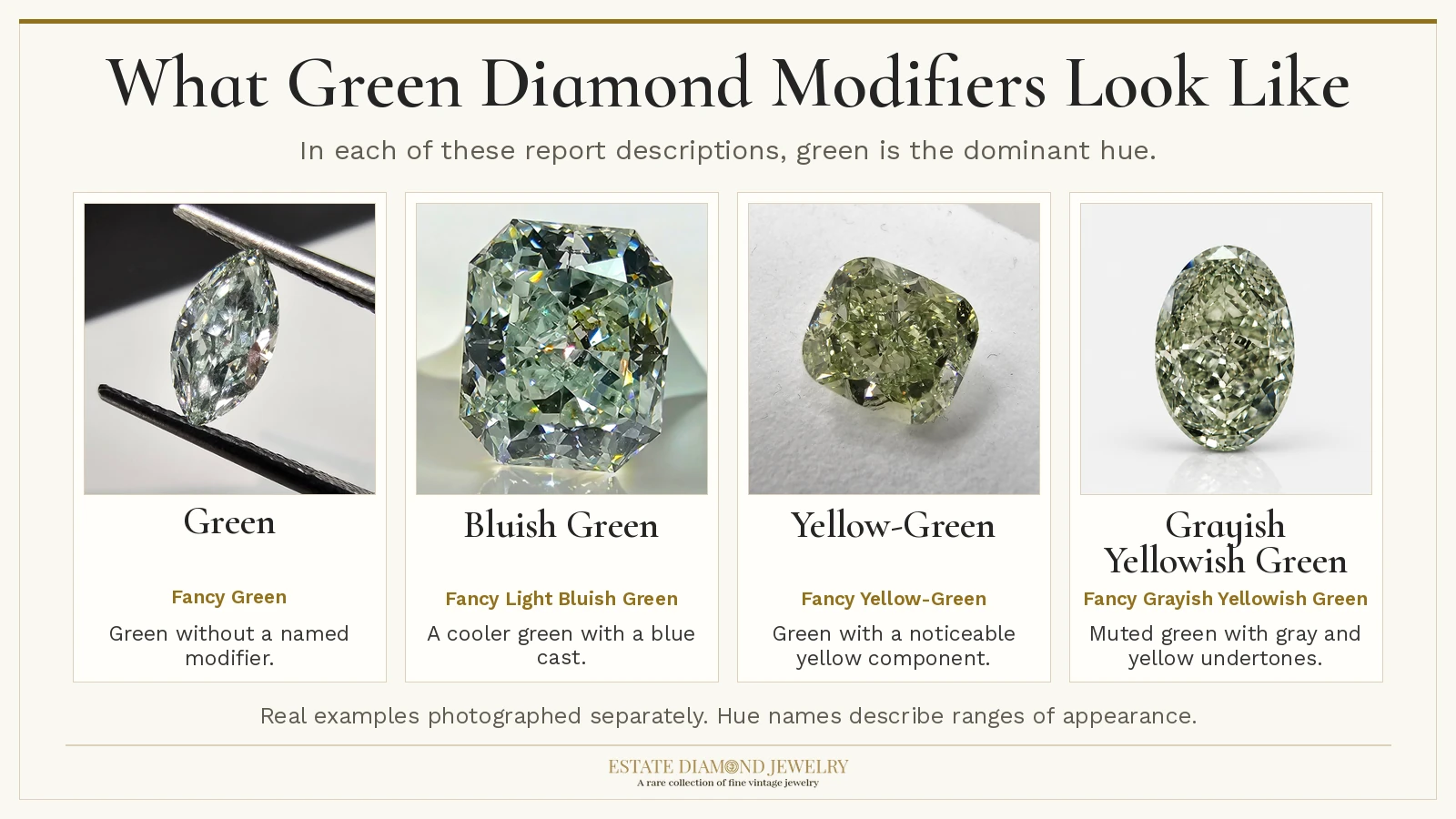
The last color word in a GIA fancy-color diamond description identifies the predominant hue. A Fancy Yellowish Green is predominantly green with a yellow modifier. A Fancy Greenish Yellow is predominantly yellow with a green modifier. A Fancy Yellow-Green is predominantly green, with a more pronounced yellow component than yellowish green indicates. Meaningful comparisons depend on the complete grade as printed on the report, including the order of the words and any hyphen.
| Color wording | Modifier | Face-up appearance |
|---|---|---|
| Green | None named | Green with no secondary color named in the grade |
| Yellowish Green | Yellowish | Warm green with a slight yellow cast |
| Yellow-Green | Yellow | Green with a more pronounced yellow component |
| Bluish Green | Bluish | Cool green with a slight blue cast |
| Blue-Green | Blue | Green with a more pronounced blue component, sometimes approaching teal |
| Grayish Green | Grayish | Muted green with a gray cast |
| Brownish Green | Brownish | Earthy green with a brown cast |
| Grayish Yellowish Green | Grayish and yellowish | Muted warm green with both gray and yellow undertones |
| Grayish Yellow-Green | Grayish and yellow | Muted green with a more pronounced yellow component |
| Grayish Bluish Green | Grayish and bluish | Muted cool green with blue and gray undertones |
A yellow modifier can give a green diamond a warmer appearance. A bluish modifier can give it a cooler cast, while grayish or brownish modifiers can make the color appear more subdued. The modifier is part of both the visual character and the market comparison. Buyers who prefer a warmer yellowish green, for example, can evaluate comparable stones within that hue before deciding whether the premium for a different color description is justified.
4. Color Distribution and Visible Zoning
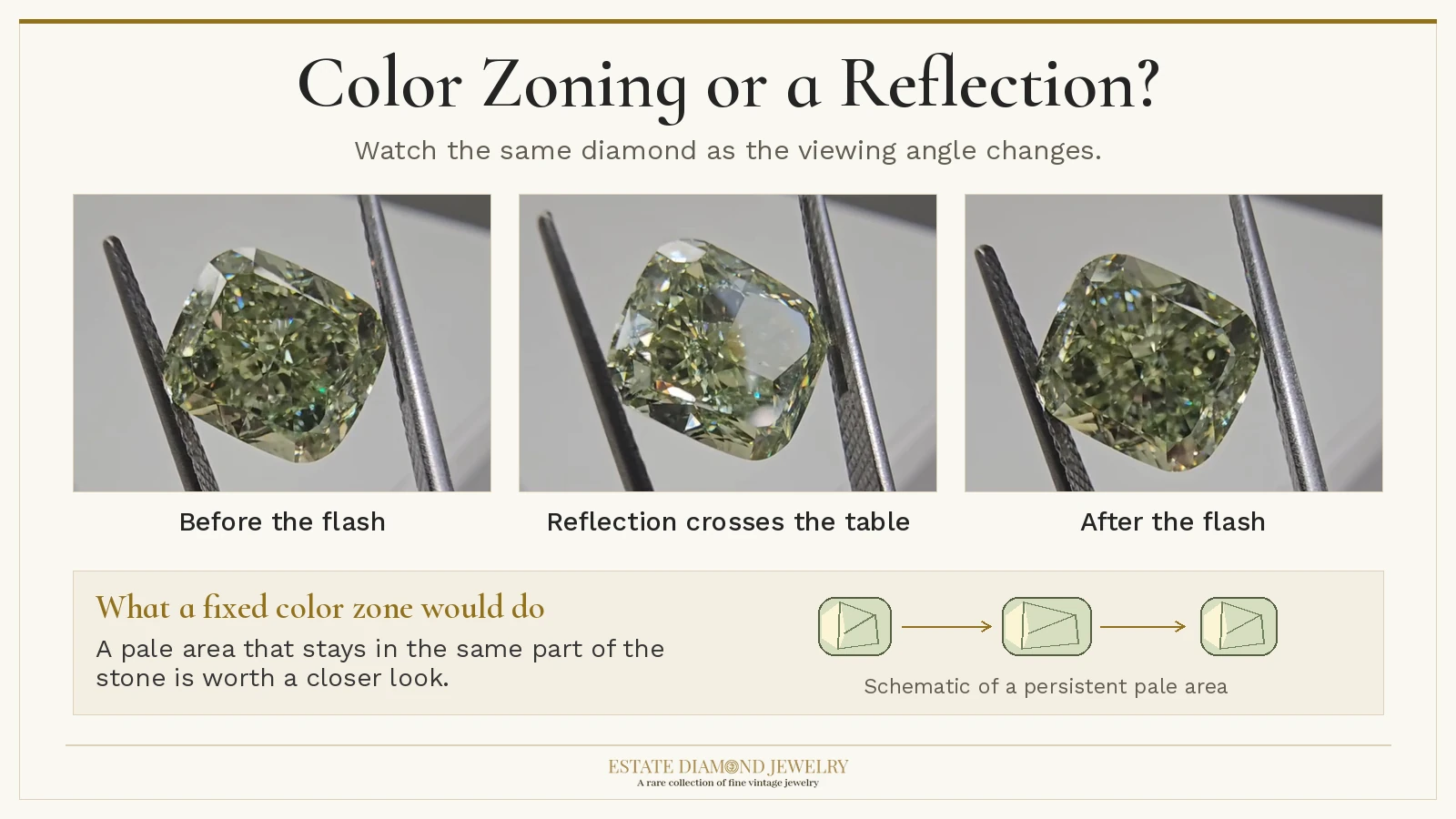
In GIA’s Color Distribution field, Even indicates that the characteristic color predominates face-up. Uneven indicates that other areas are sufficiently prominent to interrupt that overall impression. Even distribution can still show lighter reflections and darker facets as the diamond moves. Uneven distribution can be visually acceptable when the difference is subtle at normal viewing distance.
A slow face-up video against a neutral background can reveal how the center and ends of the diamond respond as it turns. In an elongated stone, those areas may appear quite different. A pale area that consistently appears in the same part of the diamond warrants a closer look for color zoning. Reflections that shift with the angle provide a different clue. Viewing the movement helps assess an effect that a single favorable photograph can conceal.
5. Trade Terms Like Mint, Apple, Olive, and Chameleon
Mint, apple, olive, and forest green are informal trade descriptions that help communicate a color preference. A dealer may describe a yellowish-green diamond as apple green, for example. The application of these terms varies by seller, so the laboratory’s complete hue and intensity description provides a more consistent basis for comparison.
Chameleon has a specific meaning in the diamond trade. It describes a diamond that changes color temporarily after gentle heating or a period in darkness. GIA can document the behavior in a report comment. For a purchase, the comment establishes whether the effect was identified, and a video in ordinary lighting shows the stone’s stable color.
6. Color Origin
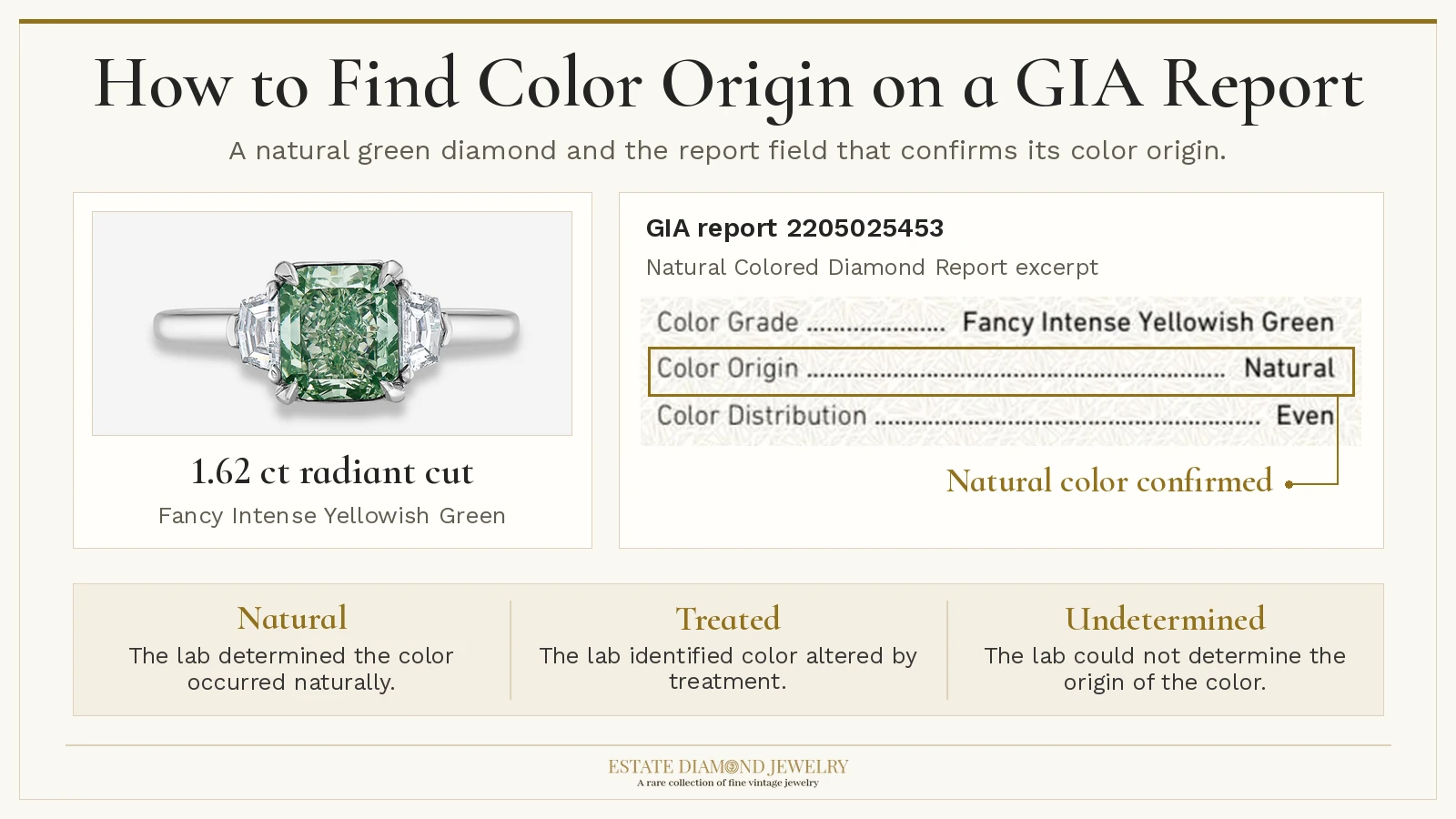
Establishing origin involves two distinct determinations: where the diamond formed and how it acquired its green color. A natural diamond may have natural or treated green color. A lab-grown diamond formed in a laboratory and may have undergone post-growth treatment. The color grade describes appearance. Origin and treatment are addressed separately on the relevant laboratory documentation.
On a natural diamond’s report, the Color Origin entry can read Natural, Treated, or Undetermined. The last finding means the laboratory identified the diamond as natural while leaving the origin of its color unresolved. Natural and laboratory irradiation can produce very similar features, even under advanced testing. A green patch at the girdle or a vivid face-up appearance is insufficient evidence on its own. A natural-color premium is justified only when the report confirms natural color.
7. How Cut Affects Face-Up Color
In some green diamonds, a shallow colored area near the surface contributes to the face-up appearance. A cutter may preserve a patch of the original rough at the girdle to retain color. Such a feature may also assist a laboratory in assessing color origin. Recutting or repolishing can remove material that contributes to the appearance, which is why a specialist should assess a worn edge before any work is undertaken on a green diamond in an older piece.
Facet arrangement affects how the color appears across the face of the diamond. A cut that retains depth can help concentrate color, although extra depth can also reduce the visible size for a given weight. A comparison should include the length and width in millimeters as well as a side-by-side examination under consistent lighting. A smaller stone with green across its center and good brightness can have greater presence in a ring than a larger stone with a broad, persistently dark area.
8. Clarity, Transparency, and Durability
Clarity is best assessed first at normal viewing distance and then under magnification. An inclusion beneath the table, the large flat facet on top, may draw the eye. A cloud may reduce transparency if it produces visible haze. Magnification helps establish where the inclusions sit and whether they affect durability. In an engagement ring, a surface-reaching feather near an exposed point warrants particular attention from the jeweler responsible for setting the stone.
A higher clarity grade carries less practical benefit when the difference is invisible in ordinary wear. If the lower-clarity diamond has more attractive green and its inclusions are unobtrusive and present no durability concern, the stronger appearance can justify choosing it. The relative weight given to clarity changes when an inclusion diminishes transparency or threatens an exposed edge.
How to Verify a Green Diamond’s GIA Report
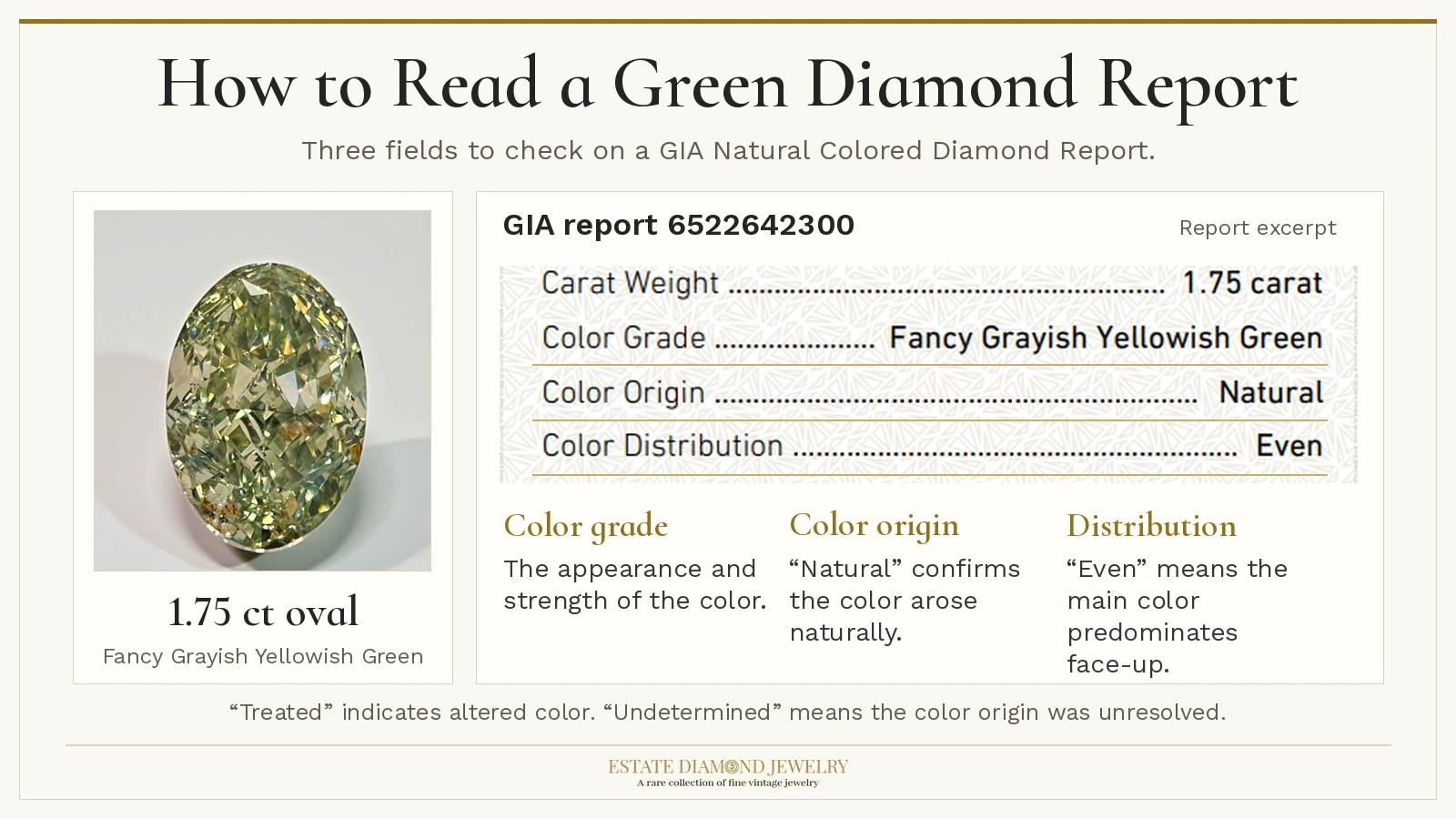
A full report should be reviewed before a deposit is considered. GIA’s Colored Diamond Grading Report includes a clarity assessment and plot for eligible loose stones. Its Colored Diamond Identification and Origin Report can identify the color origin of both mounted and loose natural diamonds. The exact information available depends on the report type.
- Report verification. The report number can be checked against the laboratory’s records.
- Stone identification. The shape and measurements should match the diamond. A jeweler can verify a listed girdle inscription when the setting permits access.
- Color and condition. The Color Grade, Color Origin, and Comments fields merit particular attention. The buyer should confirm whether the stone has been reset, repaired, or recut since the report was issued.
How Much Does a Natural Green Diamond Cost?
Natural green diamonds can vary considerably in price, even at the same carat weight. The value depends on the exact hue, how strong and evenly distributed the green appears, and whether the color is natural. For a finished ring, the mounting and accent diamonds also contribute to the price.
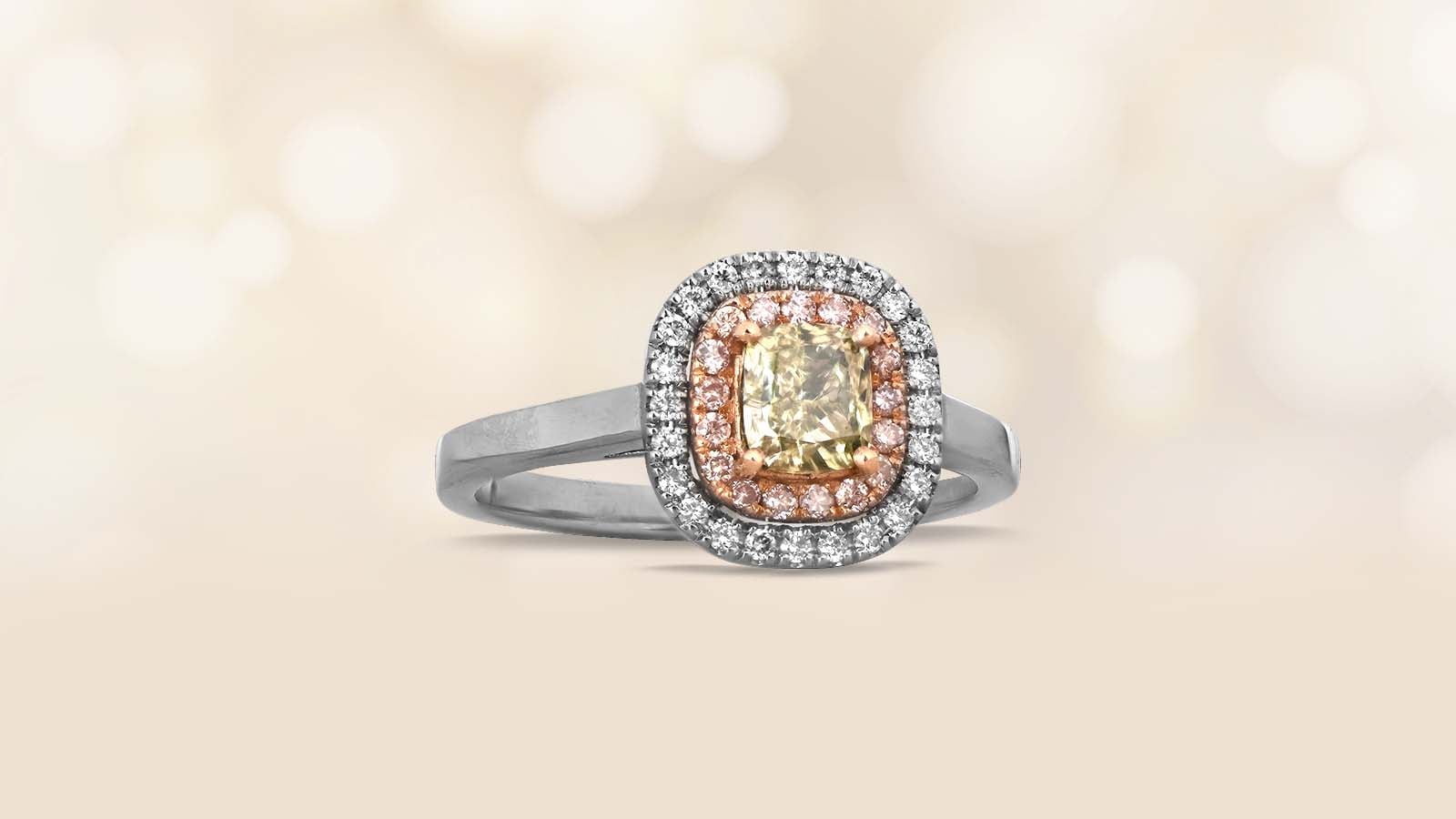
A double-halo ring from our private collection with a 1.03-carat Fancy Grayish Yellowish Green cushion was offered at about $26,000. A 2-carat Fancy Light Grayish Yellowish Green princess cut in a pink diamond halo was offered at about $34,000. A convertible ring and pendant with a roughly 1-carat Fancy Intense Yellow-Green cushion and a substantial white diamond halo was also offered at about $34,000.
These are approximate asking prices for the finished pieces. The two cushion-cut centers are close in weight, yet their color grades and mountings differ. For a meaningful price comparison, start with diamonds of similar color origin, hue, and intensity, then account for what is included in the finished ring.
Important Warning: Lab-Grown Green Diamonds
Laboratory production makes larger stones with saturated green available at a lower entry price than comparable-looking stones with natural color. Buyers should assess a lab-grown green diamond against other lab-grown examples of similar weight, shape, and appearance. A high insurance appraisal, a steep advertised discount, or a comparison with a rare natural-color diamond can create an inflated impression of resale value. Buyers who expect to recover even a meaningful share of a substantial retail purchase should approach lab-grown green diamonds with particular caution.
“Lab-grown diamonds can be genuinely beautiful,” says Afshin Shaddiae, expert at EDJ. “But some of the prices being asked for them are problematic. These lab-grown stones can be produced in mass volume, so I see no reason to price them like rare, precious gems. For the loose stone itself, I’d put my ceiling at $200 to $300 per carat. Anything above $300 per carat is a red flag.”
Paying a premium for a lab-grown colored diamond can lead to buyer’s remorse when it comes time to sell. Some buyers find that the best offer they receive is less than 5% of what they originally paid.
That is why Estate Diamond Jewelry sells only natural diamonds with untreated color.
Choosing a Green Diamond Engagement Ring
Diffuse daylight and ordinary indoor lighting are both useful for evaluating a green diamond. A mounted stone can be assessed on the hand at normal viewing distance. A loose stone can be viewed against a sample of the intended metal. Yellow gold can emphasize the warmer notes in the center diamond, while white accent diamonds provide a neutral reference that makes the hue easier to judge.
The Barrow ring from the Estate Diamond Jewelry illustrates how the setting affects presentation. Its 1.10-carat center is bezel-set in 18-karat yellow gold, with white round and baguette diamonds set in platinum. The face-up view shows how the bezel frames the green center. The side view shows how closely the setting sits to the finger, a consideration for a ring intended for daily wear.
When a choice comes down to a larger diamond that shows green only at certain angles and a smaller stone with clear color in ordinary light, the smaller stone may be the better choice for daily wear. The same examination matters in a vintage ring, where a distinctive mounting can make it easy to overlook how the center diamond behaves away from display lighting.
Two Famous Green Diamonds
The Dresden Green weighs approximately 41 carats and has a soft, celadon-green appearance. It survives in an elaborate 18th-century hat ornament associated with the Saxon court. The ornament took its present form in 1769, incorporates earlier elements, and is part of Dresden’s Green Vault collection. The diamond’s soft green remains visually distinct against the surrounding diamonds. The Metropolitan Museum of Art on the Dresden Green
The Aurora Green is an example of exceptionally strong natural color at a substantial weight. Christie’s described the 5.03-carat diamond as a natural Fancy Vivid Green and reported that it sold for HK$130,040,000, approximately US$16.8 million, in Hong Kong in 2016. The Aurora’s combination of size, intensity, and documented natural color places the auction result in the context of exceptional collector demand. Christie’s auction announcement
Frequently Asked Questions
1. Are green diamonds real, and how rare are they?
Natural diamonds can have naturally occurring green color. Especially scarce are polished stones with saturated natural green that remains apparent face-up. A slight green tint, a treated green, and a strong natural green fall into different market categories. The laboratory report establishes the color description and confirmed origin.
2. How does a green diamond differ from an emerald?
An emerald is the green variety of beryl. Emerald is softer than diamond and can require special care, particularly when it has surface-reaching fractures or clarity treatment. A side-by-side comparison under the same light shows the different character of the two gems, including the brighter flashes of a faceted diamond and the softer glow of some emeralds.
3. Does “Undetermined” mean a green diamond was treated?
An Undetermined finding indicates that the laboratory could not establish whether the green color occurred naturally or resulted from treatment. Buyers seeking a natural-color green diamond should look for Natural in the Color Origin field.
4. Can a lab-grown green diamond be resold?
A lab-grown green diamond can be resold if a buyer is available. The proceeds depend on the stone, the buyer, the sales channel, and any fees. For a ring, a separate offer on the loose stone helps distinguish the value of the diamond from the value of the setting. Store credit should be evaluated alongside any additional purchase required to redeem it.
Talk to a Green Diamond Expert
Whether you’re evaluating a diamond you’ve already found or looking for a natural green diamond for an engagement ring, the specialists at Estate Diamond Jewelry can help. They can review the grading report with you, explain how the color and cut affect the price, and show you comparable stones.
Contact Estate Diamond Jewelry to discuss a specific diamond or inquire about pieces from our private collection.
For a comparison with pink, blue, yellow, and other natural diamond colors, see the companion guide. Benjamin’s complete guide to fancy color diamonds
