
Blog
Benjamin’s Expert Guide to the I Color Diamond


I color diamonds are one of the most popular consumer diamond colors, and for good reason. In this article written by Benjamin Khordipour, a leading diamond expert and author, you’ll learn exactly what you need to know about I color diamonds before moving forward with your purchase.
Do you have specific questions about diamonds? Feel free to talk directly with a diamond expert.
What Is an I Color Diamond?

The I color diamond sits in the sixth position on the GIA scale of diamond color, and is considered a “Near Colorless” diamond. This means that to the naked eye, it will appear white, but unlike the higher-graded diamonds, the I-color diamond will cost significantly less.
For many shoppers, the I color is considered the “sweet spot” because you get a stone that looks high-quality without paying a premium price for rarity that will be hardly noticeable.
While an I color diamond has a very slight hint of yellow warmth, this tint is usually only visible to a professional gemologist. Choosing an I color is a strategic move for a buyer who wants to prioritize a larger carat size or a better cut while still maintaining a white appearance.
How Much Does an I Color Diamond Cost?

I color and J color diamonds are among the most popular commercial colors because they’re at the intersection of a good presentation and incredible prices.
Below are the current market prices for I color diamonds.
| Carat Weight | VS2 clarity | if clarity |
|---|---|---|
| 0.50-Carat, Round, and I Color | $770 | $1,100 |
| 1.00-Carat, Round, and I Color | $3,850 | $5,280 |
| 2.00-Carats, Round, and I Color | $20,460 | $29,700 |
| 3.00-Carats, Round, and I Color | $52,800 | $72,600 |
| 4.00-Carats, Round, and I Color | $92,400 | $123,200 |
| 5.00-Carats, Round, and I Color | $140,250 | $200,750 |
| 6.00-Carats, Round, and I Color | $168,300 | $240,900 |
Looking for an I color diamond? Fill out the form below to see our wholesale prices.
Shop I Color Diamond Rings and Jewelry
Looking to buy an I color diamond ring or jewelry? Feel free to browse our collection. Alternatively, you can reach out to us with the contact form below and we can let you know our wholesale prices.
Pros and Cons of Buying an I Color Diamond
The primary pro of choosing an I color diamond will be the exceptional value that it offers. Because it sits in the “Near Colorless” range, it typically will cost at least 40% less than diamonds in the “Colorless” category (D-F), even though it looks almost identical to the naked eye (especially when set in a ring). This price gap allows you to “buy up” in other areas that are often more visible (such as a carat weight or clarity). Additionally, the slight warmth of an I color diamond can be offset inside the jewelry mounting, if you know what you’re doing. See below.
The main con of an I color diamond is that its slight yellow or brown tint can become more apparent in certain situations, especially when purchasing an “intense” I color. For instance, the tint is more likely to be noticed in stones larger than 2-carats or in shapes with large facets, like Emerald or Asscher cuts (which won’t hide the color as well as a round diamonds). Furthermore, if the diamond is set in a platinum or white gold mounting, a very sensitive eye might detect a faint warmth when viewing the stone from the side. For those who are strictly looking for a icy-cold look, an I color diamond might feel too warm.
“There is a good reason that the I color diamond is very popular right now,” says Michael Khordipour. “The price reduction from the lowered color grade, enables the couple to get a bigger diamond. And almost all couples rather a bigger diamond than a whiter diamond.”
Afshin’s Expert Tips for Buying an I Color Diamond
I reached out to Afshin Shaddaie, a leading jewelry veteran, for his top tips for buying an I color diamond. Here’s his advice:
- Prioritize round and brilliant cuts. Diamonds that have more sparkle have an easier time in hiding the yellowness of the gemstone. Round, old Euro, cushion, marquise, pear, oval will be preferred. Try to avoid step cuts like emerald and Asscher.
- Antique diamonds face-up whiter. A great trick is to buy an antique I color diamond. Old diamonds like the old European cut, antique cushion cut, or old mine cut will appear much whiter, especially when looking down over the diamond. Often an antique I color diamond will seem equivalent to a modern G or H color. See below.
- Consider Yellow or Rose Gold settings. One of the most popular tricks to give an impression that the diamond is whiter than it is will be too place it into a yellow mounting. Those looking at the diamond will think that its appearing yellow because of the mounting.
- Surround the diamond with yellower diamonds. This tip is very similar to the previous trick, but is also very effective. Afshin recommends using K or L colored diamonds for the halo, shoulders, or accents. This will give an impression that the center diamond is far whiter by comparison.
- Ask for a video of the diamond. The yellowness of the I color diamond will be a subjective opinion based on the gemologist who graded it. Afshin recommends asking for a video to see how strong the yellowness is in the diamond.
- Negotiate with the jeweler. If you’re buying the diamond from a smaller online boutique, they may be willing to work with you on the price. Read my article on how to negotiate with your jeweler.
Best Pairings for an I Color Diamond
As mentioned above, for the most flattering look, setting your diamond in yellow or rose gold will provide a warm backdrop that makes an I color stone appear crisp and white. That being said, many couples will rather platinum for its stunning color and its hypoallergenic qualities.
Beyond the metal, the most critical pairing will usually be to find a diamond with at least an “Ideal” cut. This will ensure that the diamond reflects maximum light to mask any subtle tint. To further enhance this effect, pair the color grade with a round shape, as its specific facet pattern is superior to elongated shapes.
In terms of technical specifications, choosing a diamond with “Medium Blue” fluorescence is a pro-level pairing because the blue light naturally offsets faint yellow tones, acting like a whitener in sunlight. This should also bring down the price by a lot.
Additionally, I recommend to aim for an at least “Eye-Clean” clarity grade, such as VS2 or SI1, as this allows you to invest more of the remaining funds into a larger carat size.
I Color Diamond Comparisons
For serious shoppers looking to pinpoint whether to buy an I color diamond, comparing it to its nearest neighbors on the scale is the best way to understand what you are paying for. But first here is an H color, I color and J color diamond ring as they appear on the hand.
H Color vs I Color
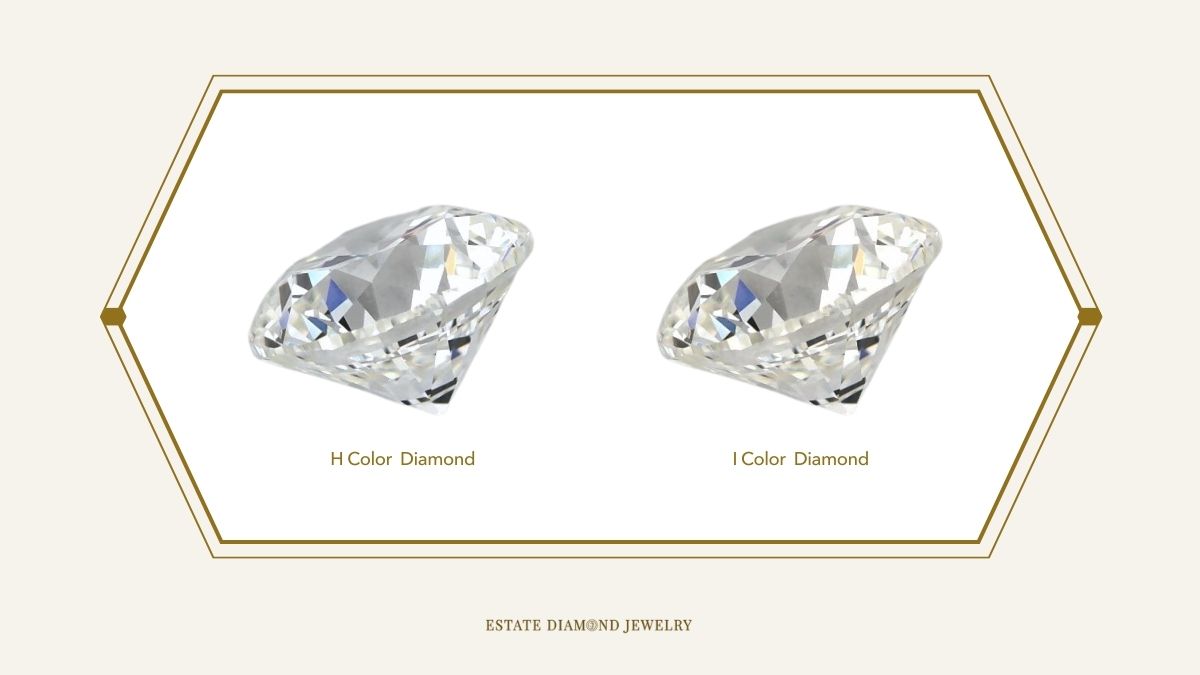
When comparing H vs. I color diamonds, you are looking at two popular grades in the “Near Colorless” category. An H color diamond is slightly higher on the scale and is often considered the “safe” choice for white gold or platinum settings because it has almost no detectable tint to the untrained eye. However, the I color diamond will cost a nice amount less than an H color of the same size and quality.
For a serious buyer, the visual difference is so microscopic that it is often invisible once the stone is mounted. Choosing the I color allows you to reallocate those savings into a significantly better cut or a larger carat weight without sacrificing the “icy white” look of the ring.
Learn about the H color diamond.
I Color vs J Color
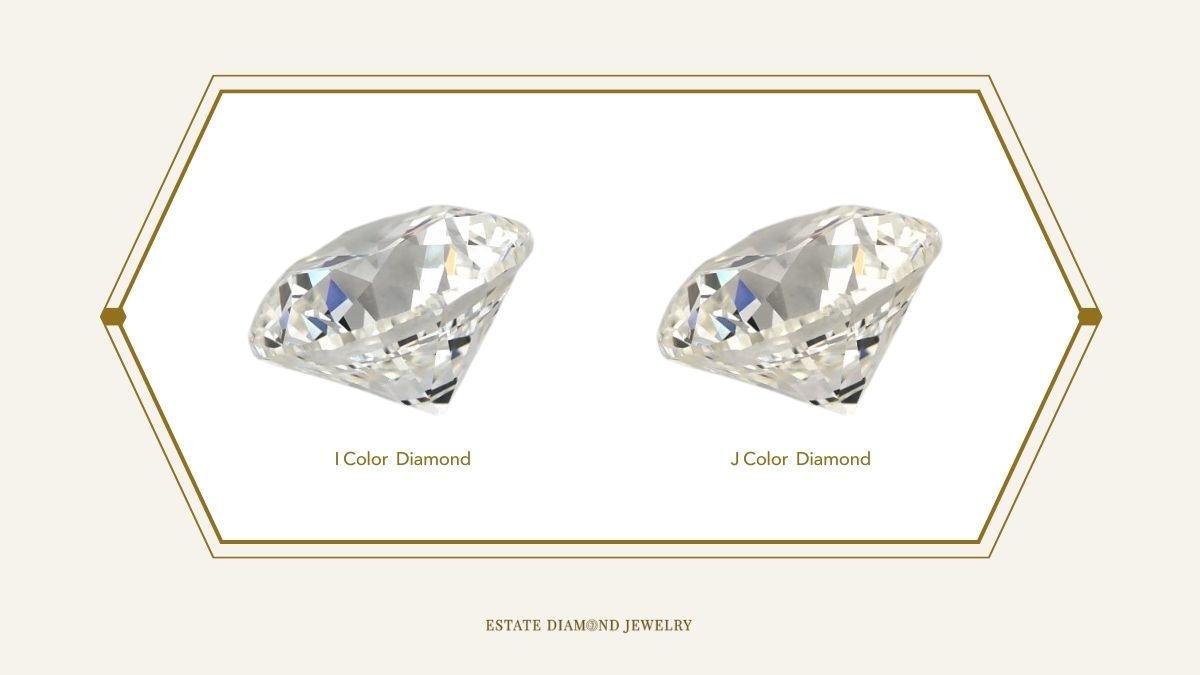
The comparison between I vs. J color diamonds is where the trade-off between price and warmth becomes more distinct. While both are “Near Colorless,” the J color diamond will be the final grade in the category, and will often show a more noticeable “warmth” or soft ivory tint, especially when viewed from the side.
Because of this, J color diamonds are priced even more aggressively lower than I color stones.
A good compromise that we’ve seen many customers do is purchase an antique J color diamond and get the best of both worlds.
For buyers, though, who want a modern stone that still feels “white” in most lighting conditions but remains budget-friendly, the I color acts as a superior middle ground compared to the more obviously tinted J color.
Learn about the J color diamond.
Understanding the Antique I Color Diamond
For the serious collector, buying an antique I color diamond, such as an Old European or Old Mine cut, is considered a “master hack” for achieving a high-end look at a fraction of the cost.
These vintage stones were hand-faceted to shine in candlelight, resulting in larger, broader facets that are designed to play with light and shadow rather than just high-brilliance sparkle. Because of this unique light performance, antique cuts tend to “mask” warmth much more effectively than modern cuts.
An antique I color diamond will often present a softer white that feels intentional rather than “tinted.” Furthermore, because the diamond industry today prioritizes modern brilliance, you can often find these character-rich, antique I color stones at a significant discount.
Frequently Asked Questions
1. Is an I Color Diamond Considered “White”?
Depends, the GIA officially classifies I color as “Near Colorless,” and not “Colorless.” That being said, it will appear perfectly white to almost all laymen when set in a ring or a jewelry mounting. Only a professional or someone with a very good eye will see the slight warm tint.
If you are looking for an “icy white” look, though we recommend going for a diamond that graded as D, E or F color.
2. How do I Ensure I’m Not Getting a “Yellow” I Color Diamond?
As mentioned in the article above, there is a spectrum of yellowness in an I color diamond. Even asking for a certification may not help at all, because the gemologist who graded the diamond will be subjective. We recommend asking the seller. So long as the seller is honest and knowledgeable, they’ll be able to tell you the yellowness of the I color diamond.
3. Which Diamond Shape is Best for an I Color?
Assuming that you haven’t already decided the diamond shape that you want, the brilliant cut diamonds will be a lot better at hiding the yellowness of the I color diamond. “Fancy” shapes with large, open facets or step cuts like the emerald or Asscher cuts will tend to show a lot more of the yellow color.
4. Is an I Color Diamond a Good Investment for an Engagement Ring?
I color diamonds are very likely to be a “good investment” in the typical sense of the word as they are a luxury purchase and will tend to lose value.
That being said, many experts consider the I color and the J color to be the perfect “value play” for diamond engagement rings. Those diamonds allows you to maximize your budget for a larger carat size or a better cut.
5. Should I Buy a Lab Grown I Color Diamond?
No. We strongly believe that lab-grown diamonds are a very bad purchase idea. Read our article in which we explain everything that you should be warned about before you buy a lab-grown diamond.
Talk to a Diamond Expert

Looking to purchase an I color diamond? Contact one of our expert jewelers. We will respond within one business hour.
D Color | E Color | F Color | G Color | H Color | I Color | J Color | K Color | L Color | M Color
