
Blog
Expert Guide to Understanding Cartier Art Deco Jewelry


Cartier’s Art Deco jewels are among the most influential creations in twentieth-century jewelry, yet understanding what makes a period example important requires far more than recognizing a signature or geometric design.
This guide examines Cartier’s defining materials, techniques, motifs, signatures, and celebrated creations while explaining what serious collectors should consider before acquiring a piece. Its author, Afshin Shaddaie, has spent decades examining and acquiring rare vintage jewels and, together with Michael Khordipour, has assembled an exceptional private collection of Cartier Art Deco jewelry that includes many pieces seldom shown publicly.
Cartier’s History During the Art Deco Era

The House of Cartier was founded in Paris in 1847 by Louis-François Cartier, but it was his grandson Louis Cartier, working alongside his brothers Pierre and Jacques, who transformed the family business into an international jewelry house. By the early twentieth century, Cartier operated through Paris, London, and New York, serving royalty, industrialists, artists, and many of the era’s most influential collectors.
Cartier’s movement toward Art Deco began before the style received its name. The delicate garlands and scrollwork of the Edwardian period gradually gave way to stronger geometry, architectural lines, bold color contrasts, and innovative platinum construction. At the 1925 International Exhibition of Modern Decorative and Industrial Arts in Paris, Cartier was the only jeweler to exhibit alongside leading fashion houses in the Pavillon de l’Élégance.
During the 1920s and 1930s, Cartier combined European modernism with artistic traditions drawn from India, Egypt, China, Persia, and the Islamic world. The resulting jewels did not merely reflect Art Deco taste; they helped define its most sophisticated expression.
Dominant Designs of Cartier Art Deco Jewelry
Cartier’s Art Deco jewelry cannot be defined by a single appearance. During the 1920s and 1930s, the house developed several distinct design languages, ranging from restrained diamond geometry to exuberant compositions of carved colored gemstones. The following styles are among the most important for collectors to recognize.
1. Geometric and Architectural Designs
Geometry formed the foundation of Cartier’s Art Deco style. Bracelets, rings, brooches, and earrings featured repeated squares, rectangles, circles, arches, stepped borders, and sharply defined lines. Platinum provided the strength needed to create delicate openwork structures while securely holding diamonds in old European, rose, baguette, carré, shield, and other specialized cuts.
The finest examples feel carefully balanced rather than mechanically repetitive. Cartier used negative space, graduated proportions, and precisely positioned stones to give substantial jewels a sense of lightness and movement.
2. Black-and-White Designs
Some of Cartier’s most recognizable Art Deco jewels combine white diamonds with black onyx or enamel. This limited palette emphasized the structure of the design and created a dramatic contrast that complemented the black-and-white fashions of the period.
Onyx could form borders, stripes, panels, or small calibré-cut accents between diamonds. Collectors should examine these elements carefully, since damaged or missing onyx sections may have been replaced during later restoration.
3. Colored Gemstone Designs
Cartier also created vivid compositions using emeralds, rubies, sapphires, coral, jade, turquoise, lapis lazuli, and mother-of-pearl. In these jewels, the relationship between the colors was often more important than the isolated perfection of each stone.
The house’s Indian-inspired creations are especially significant. Carved emeralds, rubies, and sapphires were arranged as leaves, berries, flowers, and fruit, frequently accented by diamonds. These jewels were originally described as pierres de couleur or “Hindou jewels.” The familiar name “Tutti Frutti” was adopted much later.
4. Egyptian and Internationally Inspired Designs
The discovery of Tutankhamun’s tomb in 1922 intensified European interest in Egyptian art. Cartier incorporated scarabs, lotus flowers, temple-like forms, hieroglyphic patterns, and ancient Egyptian color combinations into jewelry and decorative objects.
Chinese, Persian, Islamic, Japanese, and Indian art also influenced Cartier’s use of hardstones, carved gemstones, lacquer, enamel, and stylized motifs. These influences were interpreted through Cartier’s own modern design vocabulary rather than copied as archaeological reproductions.
5. Transformable and Technical Designs
Many Cartier Art Deco jewels were engineered to be worn in several ways. Paired clips could be joined as a brooch, pendants could detach from necklaces, and important gemstones could be transferred between different settings.
This transformability is part of the object’s design, not merely a practical feature. For collectors, surviving fittings, matching components, and original mechanisms can greatly increase a jewel’s historical importance, rarity, and desirability.
Types of Cartier Art Deco Jewelry Collectors Prize
Cartier produced an extraordinary range of jewelry and decorative objects during the Art Deco period. Although quality and rarity must be evaluated individually, certain forms are particularly important to collectors because of their design, craftsmanship, transformability, or low survival rate.
1. Cartier Art Deco Bracelets
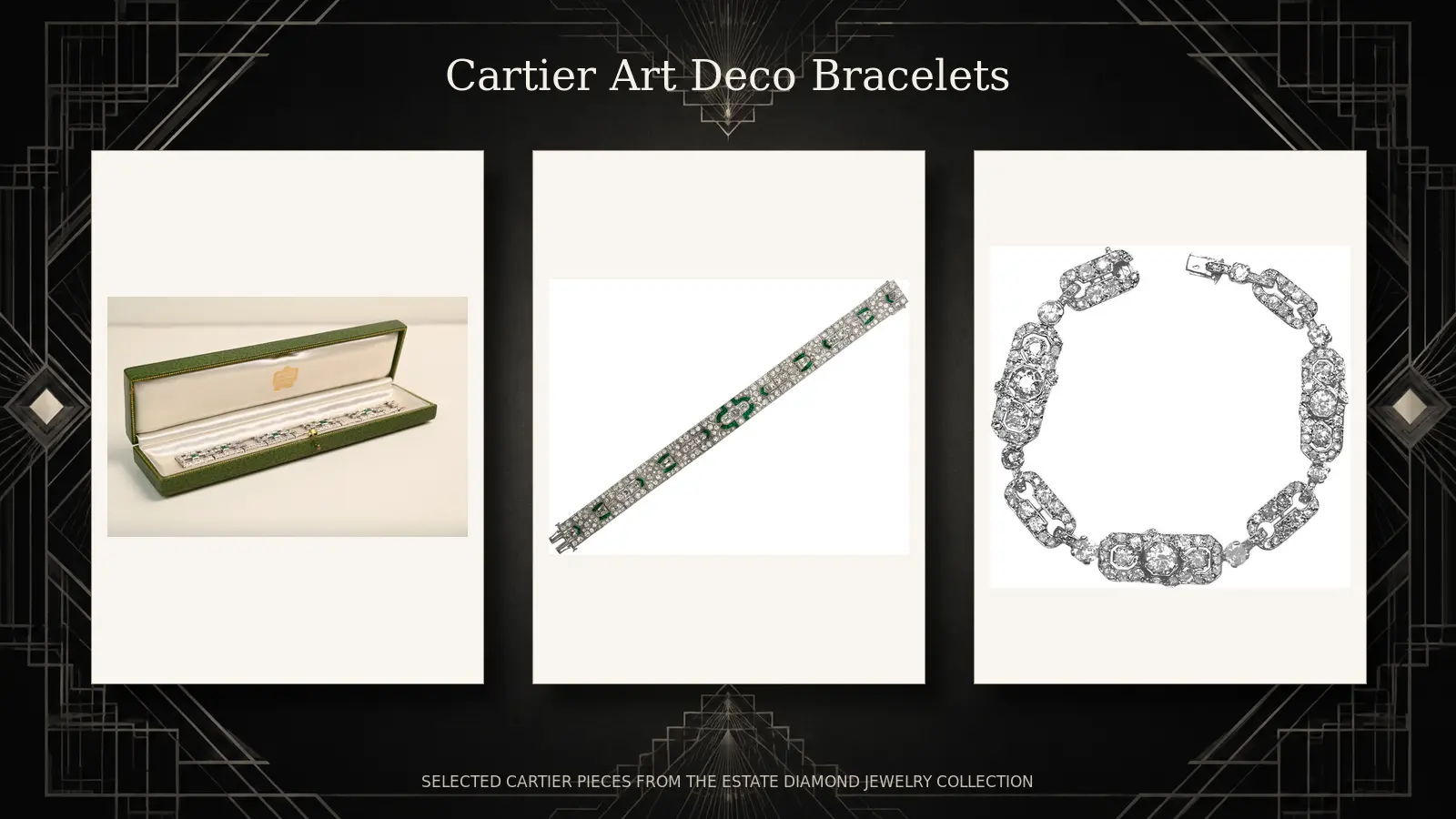
Art Deco bracelets gave Cartier a broad surface on which to develop complex geometric compositions. Diamonds could be arranged in repeating links, architectural panels, or openwork patterns, sometimes interrupted by emeralds, rubies, sapphires, or black onyx.
Collectors examine the bracelet’s articulation, clasp, safety mechanism, original length, and the consistency of its stones. A bracelet that has been shortened may be missing important parts of its original design. The Cartier emerald and diamond bracelet from our collection, created circa 1925, demonstrates how Cartier combined approximately 19 carats of diamonds with vivid emeralds in a highly articulated platinum construction.
2. Cartier Double Clips and Brooches
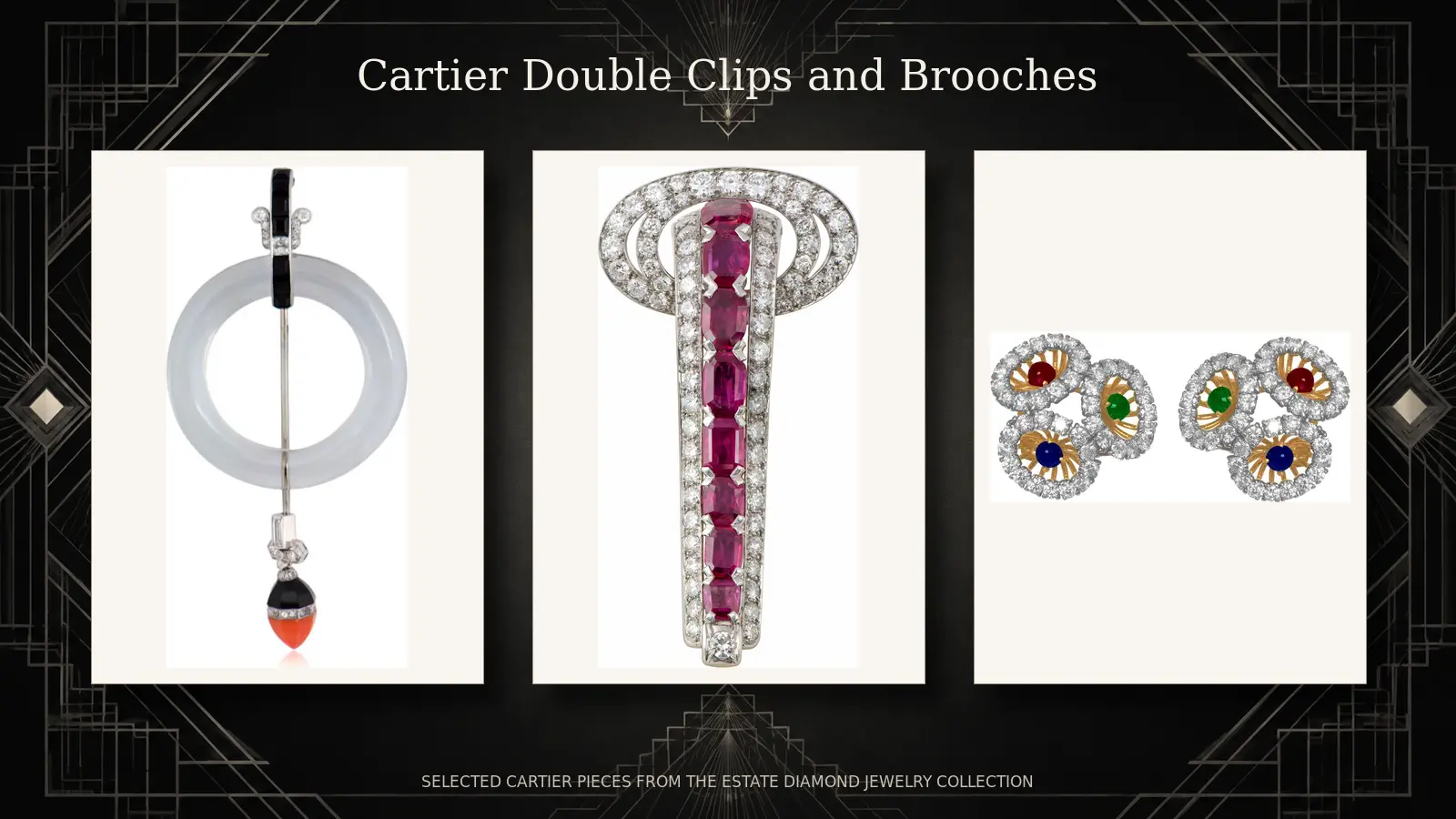
Double clips are among the most ingenious jewels of the Art Deco period. Two matching clips could be worn separately on a dress or lapel and then attached to a fitted frame to form a single brooch.
Complete pairs are generally more desirable than isolated clips because many sets were separated over time. Collectors should confirm that both clips, the brooch frame, and the attachment mechanisms belong together. Estate Diamond Jewelry’s private collection includes a rare pair of Cartier double clips set with diamonds, rubies, sapphires, and emeralds.
3. Cartier Sautoirs and Necklaces
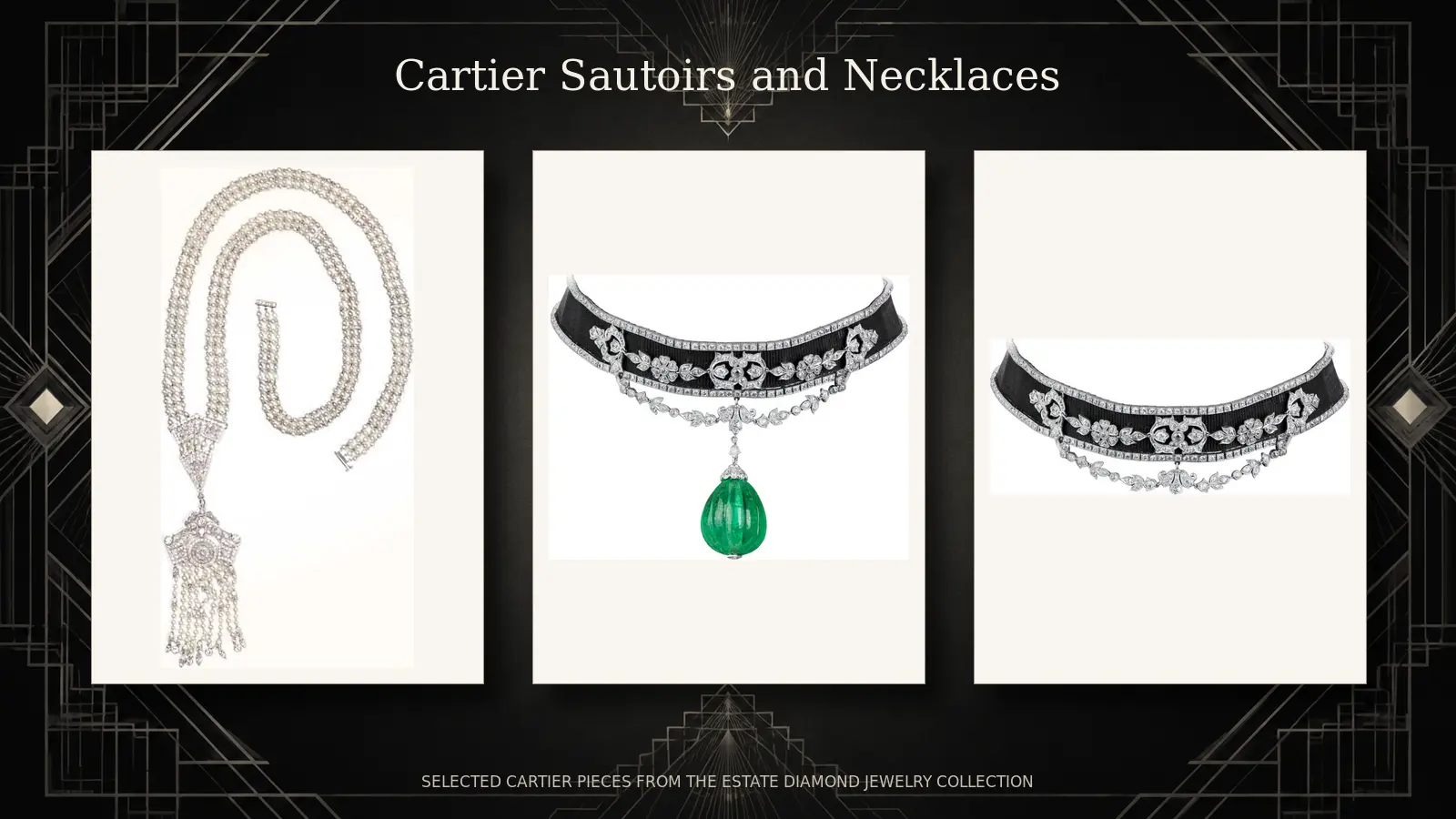
The sautoir, a long necklace frequently terminating in a pendant or tassel, became one of the defining jewels of the 1920s. Cartier created examples using diamonds, pearls, carved gemstones, jade, rock crystal, onyx, and colored beads.
Many necklaces were designed with detachable or interchangeable components. Because historic necklaces were frequently shortened, divided, or converted into bracelets and brooches, an example surviving in its original configuration can be especially important.
4. Cartier Art Deco Rings and Earrings
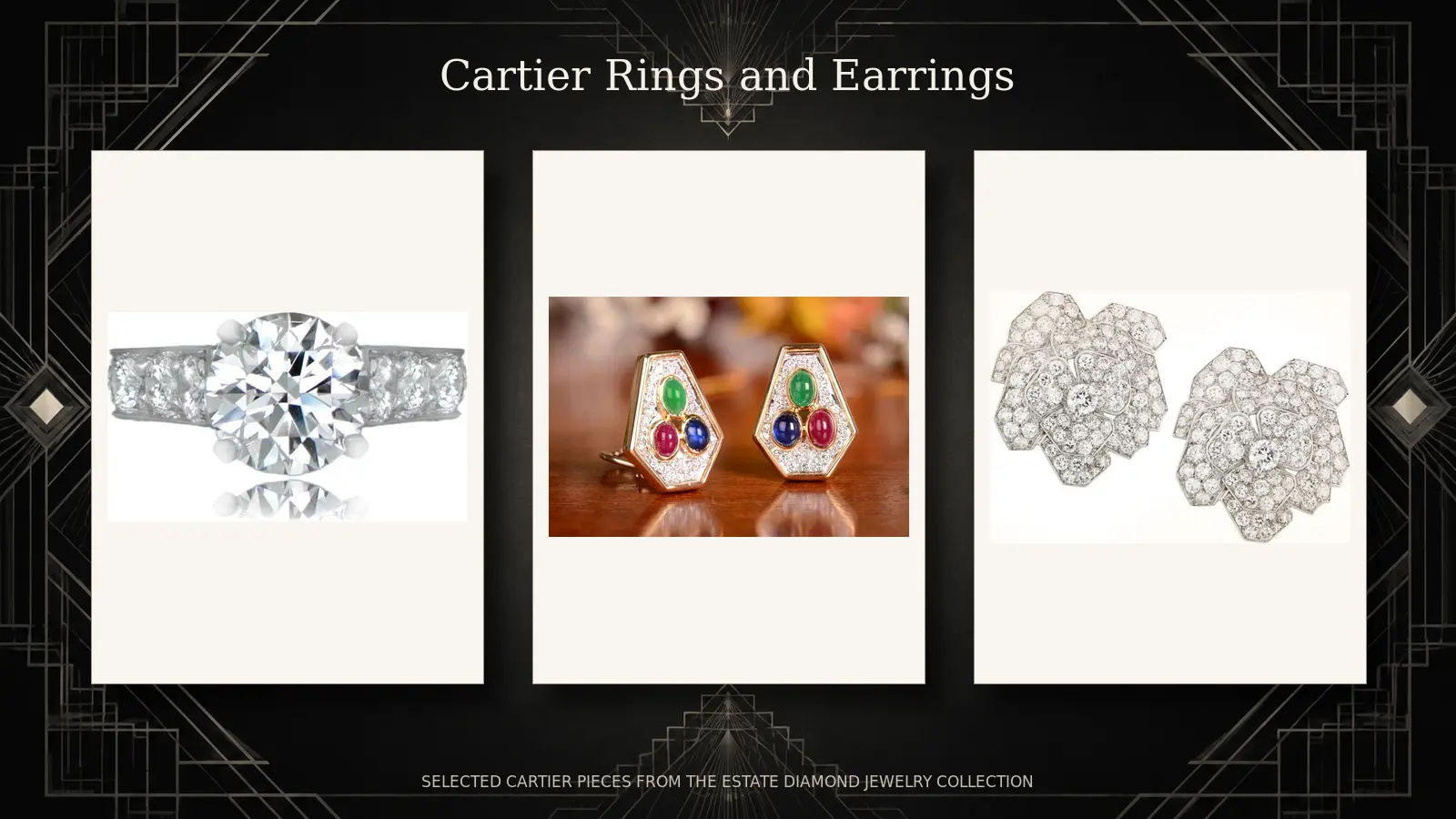
Cartier rings from this period range from restrained diamond designs to important colored-stone jewels. Collectors look for balanced proportions, unusual diamond cuts, original galleries, and consistency between the mounting and the proposed date. Resizing can weaken or partially remove signatures and numbers, making careful examination essential.
Matching earrings set with important gemstones are particularly difficult to assemble. The Cartier Burma ruby and diamond earrings in our collection contain two AGL-certified unheated Burma rubies totaling 7.56 carats. Their matched stones, geometric diamond surrounds, platinum construction, and Cartier signature give them significance beyond their visual beauty.
5. Cartier Watches, Clocks, and Jeweled Objects
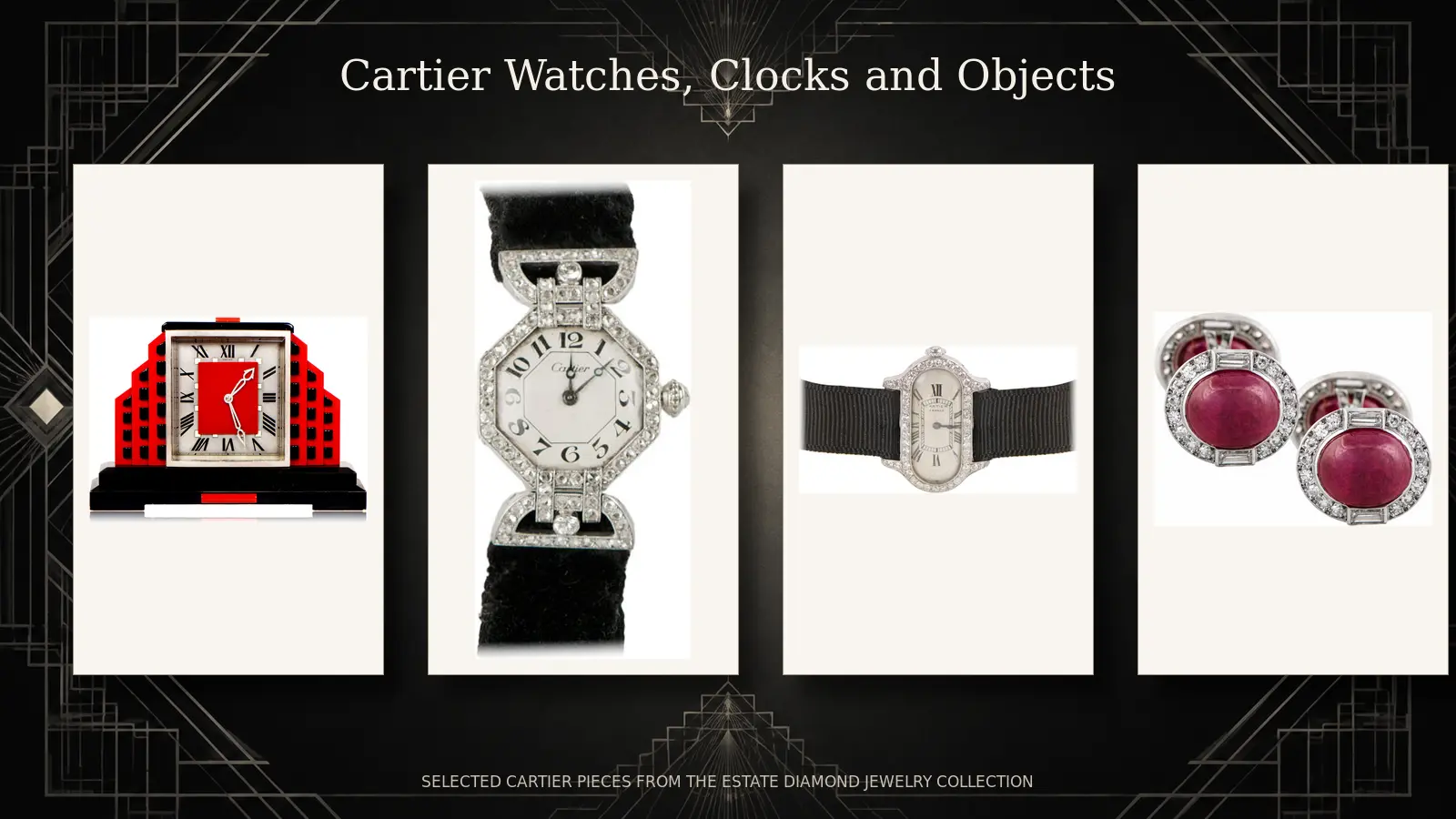
Cartier’s Art Deco production extended beyond conventional jewelry. Tank watches, mystery clocks, vanity cases, cigarette cases, desk objects, and jeweled accessories allowed the house to combine gem-setting with watchmaking, enamel, lacquer, and hardstone carving.
These objects must be evaluated for both artistic and mechanical condition. Original movements, internal fittings, compartments, clasps, and fitted cases can significantly affect their importance to collectors.
How to Authenticate Cartier Art Deco Jewelry
This section was written jointly by Benjamin Khordipour and Afshin Shaddaie, drawing upon their experience examining, acquiring, and authenticating rare Cartier and Art Deco jewelry.
Authenticating Cartier Art Deco jewelry requires far more than finding the Cartier name on a jewel. The signature, design, construction, marks, gemstones, condition, and documented history should all support the same attribution. No single feature can establish authenticity by itself.
1. Begin with the Complete Jewel
Before examining a signature, consider whether the jewel looks and feels consistent with Cartier’s work from the proposed period. Study its proportions, symmetry, choice of materials, stone arrangement, and overall refinement.
Cartier’s strongest Art Deco designs are disciplined but rarely mechanical. Even highly geometric pieces display careful transitions, balanced negative space, and a hierarchy that directs attention toward the most important stones. An awkward or poorly proportioned design should not be overlooked simply because it carries a Cartier signature.
2. Examine the Cartier Signature
Period Cartier signatures were generally engraved, but their style and placement varied according to date, branch, workshop, and type of object. On bracelets, a signature may appear near the clasp or along the edge of a link. Brooches are often signed on the reverse or side of the frame, while ring signatures may be worn from decades of contact with the finger.
Collectors should examine the lettering under magnification. A freshly cut signature on a heavily worn jewel, irregular engraving, or lettering inconsistent with known period examples deserves further investigation. Counterfeiters sometimes add Cartier signatures to authentic unsigned Art Deco jewelry, making the jewel old but the attribution false.
3. Identify the Cartier Branch
Cartier operated through Paris, London, and New York, and each branch used different signatures, numbering practices, and marks. Examples may be signed Cartier Paris, Cartier London, Cartier Ltd., Cartier New York, Cartier Inc., or simply Cartier.
The branch named in the signature should make sense when compared with the design, metal marks, construction, and proposed date. A legitimate signature cannot be evaluated separately from the rest of the jewel.
4. Study Stock Numbers, Assay Marks, and Maker’s Marks
Many Cartier jewels carry an engraved stock or inventory number, although exceptions exist, particularly among special commissions. The style, placement, and wear of the number should be consistent with the signature and age of the jewel.
French pieces may also carry government assay marks indicating metal purity and a maker’s mark identifying the workshop responsible for production. Cartier employed accomplished outside workshops to execute designs to the house’s specifications, so a workshop mark other than Cartier’s is not necessarily a concern. It can provide valuable information about where and how the jewel was made.
5. Inspect the Construction and Reverse
The reverse frequently reveals more than the front. Examine the quality of the piercing, stone-setting, joints, hinges, clasps, safety mechanisms, and finishing. Cartier’s attention to proportion and craftsmanship usually continues into areas not visible when the jewel is worn.
Look for inconsistent solder, replaced fittings, modern repairs, empty drill holes, disturbed settings, or mechanisms that do not align correctly. On transformable jewelry, confirm that the clips, frames, pendant fittings, and detachable components were designed to function together.
6. Evaluate the Gemstones and Diamond Cuts
Art Deco Cartier jewelry may contain old European, rose, single, baguette, carré, shield, calibre, and other specialized diamond cuts. Earlier gemstones were also sometimes remounted into new Cartier designs, so the age of a stone does not necessarily establish the age of its setting.
Important colored stones should be supported by respected gemological reports whenever possible. Collectors should also look for replaced stones, inconsistent cutting, mismatched color, or repairs that disturbed the original design.
“The gemstones can reveal a great deal about a jewel,” says Benjamin Khordipour. “Finding a modern round brilliant-cut diamond in a supposedly untouched antique Cartier piece is a classic red flag. It does not necessarily disprove the jewel’s authenticity, but it may indicate a replacement stone, later alteration, or incorrect dating.”
7. Investigate Condition, Alterations, and Provenance
Many period jewels have been resized, shortened, converted, repaired, or partially reset. Rings may have lost numbers during sizing, bracelets may be missing links, earrings may have modern fittings, and double clips may have been separated from their original frames.
“An important Cartier jewel does not need to be completely untouched,” explains Michael Khordipour, “but it does need to be honestly understood. A replaced stone, shortened bracelet, or converted fitting may be acceptable when properly disclosed. What damages a jewel’s integrity is an alteration that changes the original design or a history that conceals what was done.”
Original boxes, receipts, archival records, historic photographs, auction catalogues, and documented ownership can all strengthen an attribution. Provenance alone does not authenticate a jewel, but reliable documentation can connect the physical evidence with a traceable history.
Ultimately, a convincing period Cartier jewel should tell one consistent story. Its design, workmanship, signature, numbers, marks, stones, condition, and provenance should reinforce rather than contradict one another.
How to Determine the Rarity and Value of Cartier Art Deco Jewelry
Two Cartier jewels from the same period can command dramatically different prices. A signature contributes prestige, but serious collectors evaluate the complete object, including its design, gemstones, rarity, condition, originality, and history.
1. Quality and Importance of the Design
Design is one of the greatest distinctions between an ordinary signed jewel and an important Cartier creation. Collectors look for balanced proportions, confident use of color, technical ingenuity, and a composition that expresses Cartier’s recognizable design language.
As Afshin Shaddaie explains: “A Cartier signature may attract attention, but the quality of the design determines whether a jewel is simply signed or genuinely important.”
A weak or generic design does not become exceptional merely because it carries the Cartier name. Conversely, Cartier’s most accomplished creations can often be recognized by knowledgeable collectors before the signature is examined.
2. Date, Branch, and Rarity of Form
Period Art Deco jewels from the 1920s and 1930s are among Cartier’s most sought-after creations, but date alone does not establish importance. Collectors also consider whether a piece was made through Cartier Paris, London, or New York and how closely its design corresponds with the finest work associated with that branch.
Certain forms are considerably harder to find than others. Complete double clips, important articulated bracelets, original sautoirs, transformable jewels, and matched sets generally appear less frequently than individual rings or small brooches. A surviving pair can be far more desirable than two similar pieces assembled later.
3. Gemstone Quality and Historical Importance
Exceptional gemstones can elevate a Cartier jewel into an entirely different collecting category. Untreated Burma rubies, Kashmir sapphires, Colombian emeralds, natural saltwater pearls, historic diamonds, and carved Indian gemstones may contribute substantial rarity and value.
The stones must also work successfully within the design. Matching, cutting, color balance, and proportion can be as important as individual carat weights. Respected gemological reports are especially valuable when a jewel contains important colored stones or natural pearls.
4. Originality, Condition, and Completeness

Collectors do not expect century-old jewelry to appear untouched, but they do expect its condition to be accurately understood. Replaced stones, shortened bracelets, resized rings, converted earrings, repaired enamel, and altered clasps may affect value depending on their extent and quality.
Completeness is particularly important for transformable jewelry. A pair of clips accompanied by its original brooch frame is more historically complete than the clips alone. Original links, detachable pendants, fittings, and mechanical components can all contribute to desirability.
5. Provenance, Publication, and Exhibition History
Documented provenance can connect a jewel to an important collector, historic commission, royal family, or notable public appearance. Original invoices, fitted cases, archival records, photographs, auction catalogues, and published references can strengthen a jewel’s history.
However, provenance must be supported by reliable documentation. A story repeated by previous owners is not equivalent to a traceable record, and an original Cartier box does not prove that the jewel inside was originally sold with it.
6. Collector Demand and Market Availability

Value is also influenced by how frequently comparable examples become available. An exceptional period Cartier bracelet may attract intense competition because collectors could wait years for another example of similar quality.
Recent auction results can provide useful context, but they should not be treated as fixed price guides. Condition, provenance, buyer’s premiums, competing bidders, market timing, and the precise quality of the jewel can produce very different results.
Ultimately, the most valuable Cartier Art Deco jewelry combines exceptional design, rare materials, technical mastery, originality, and a documented history. It is the agreement of these qualities, rather than any one factor, that establishes a jewel’s true importance.
Exceptional Cartier Jewelry from Our Collection
Five exceptional pieces from the Estate Diamond Jewelry collection demonstrate the breadth of Cartier’s achievement: a circa 1930 Cartier Paris diamond bracelet set with 8.50 carats of old European and rose-cut diamonds; circa 1920 Cartier earrings centered on two AGL-certified, unheated Burma rubies totaling 7.56 carats; a circa 1925 Cartier emerald and diamond bracelet with approximately 5.00 carats of emeralds and 19.00 carats of diamonds; a Cartier diamond platinum brooch set with approximately 3.00 carats of F/G color, VS clarity diamonds; and vintage Cartier double clips combining approximately 10.00 carats of diamonds with cabochon ruby, sapphire, and emerald accents.
The first three are outstanding period Art Deco jewels, while the brooch and later double clips demonstrate how Cartier continued developing the era’s principles of symmetry, versatility, and gemstone contrast.
These pieces represent only a small portion of the private Cartier collection assembled over decades by Michael Khordipour and Afshin Shaddaie, which we believe ranks among the world’s most serious privately held collections of Cartier Art Deco jewelry and objects.
If you are seeking a particular Cartier jewel, complete the form below and tell us exactly what you are looking for. We may already have the right example within our collection or inventory, and if we do not, we can use our international network to find it on your behalf.
A Collector’s Checklist for Buying Cartier Art Deco Jewelry
Before acquiring an important Cartier Art Deco jewel, collectors should evaluate the entire object rather than allowing the signature or provenance to dominate the decision.
- Confirm the period. Determine whether the jewel was manufactured during the Art Deco era or is a later Cartier creation inspired by period designs.
- Document its identity. Request clear photographs of the signature, Cartier branch, stock numbers, assay marks, maker’s marks, clasps, reverse, and internal construction.
- Examine the craftsmanship. Study the platinum work, articulation, openwork, stone setting, hinges, pin mechanisms, and transformable components. These areas often reveal more than the face of the jewel.
- Identify every alteration. Replaced stones, shortened bracelets, repaired links, converted clips, later ear fittings, and reinforced clasps should be disclosed in writing.
- Evaluate the gemstones. Confirm that the diamond cuts and colored stones are consistent with the stated date. Important rubies, sapphires, emeralds, and natural pearls should be accompanied by reports from respected independent laboratories whenever practical.
- Judge importance, not merely authenticity. Design quality, rarity of form, visual strength, condition, provenance, original fittings, and publication history all influence whether a Cartier jewel is truly collector-grade.
- Protect the transaction. Purchase from a specialist willing to provide a detailed invoice, written condition disclosures, an authenticity guarantee, and sufficient time for independent examination.
A strong Cartier acquisition should withstand scrutiny at every level. A signature may begin the investigation, but it should never conclude it.
Talk to a Jewelry Expert

Art Deco marks one of the most memorable and trend-setting periods of jewelry design. It was also the time that the House of Cartier made a name for itself by introducing several Art Deco trends that people still follow to this day. Cartier Art Deco jewelry is like no other, and that’s exactly why it’s so adored.
If you want to see our rare private collection of Art Deco Cartier Jewelry, then you have come to the right place. All you need to do is tell us what you’re looking for, and we’ll show you the pieces in our collection.
Hist
