
Blog
Benjamin’s Guide: Emerald Cut vs. Asscher Cut Diamond


Emerald cut diamonds and Asscher cut diamonds are so similar in so many ways, and yet they are two separate diamonds shapes. In this article, Benjamin Khordipour will explain everything that you need to know before you move forward with buying one of these diamond cuts.
What is an Emerald Cut and Asscher Cut?
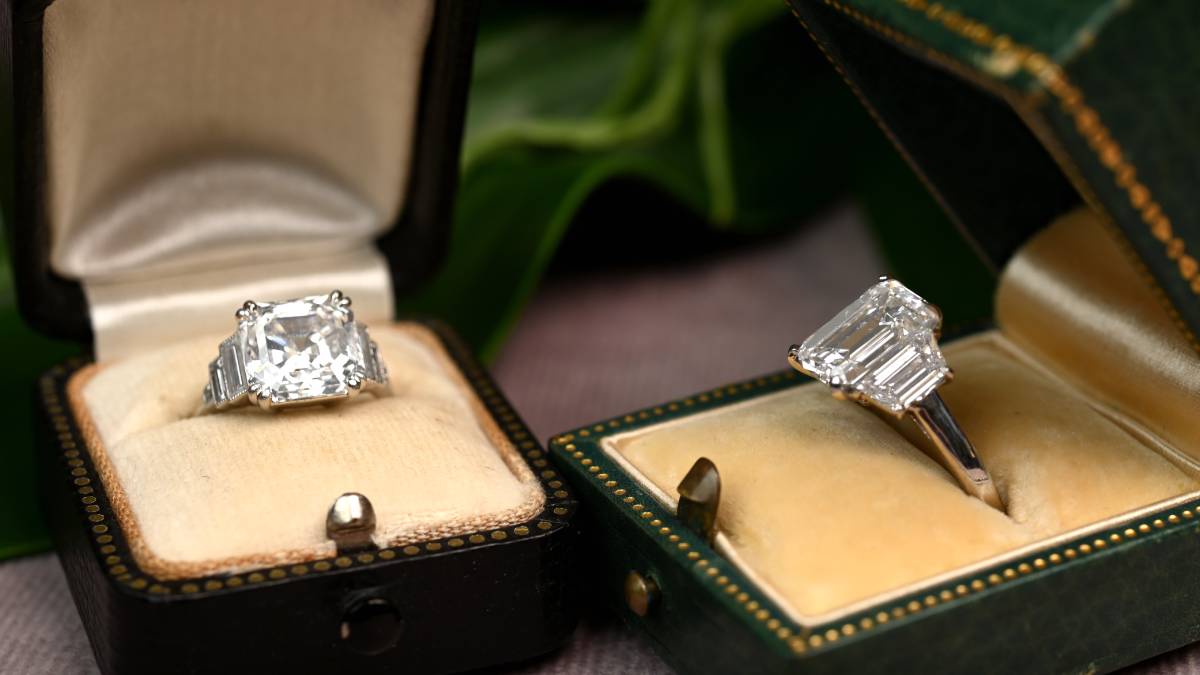
The emerald cut and the Asscher cut are two different types of step-cut gemstone shapes. Both diamond shapes are known for their mirror-like facets and elegant hall-of-mirrors effect.
The emerald cut is rectangular with cropped corners and long, parallel step facets that create a sleek, elongated appearance. This cut emphasizes clarity and luster over sparkle. Instead of fiery brilliance, an emerald cut produces bold flashes of light. Its usually worn along the length of the finger and portrays sophistication and glamour. This cut is very popular with celebrities. Emerald cuts typically have a length-to-width ratio between 1.30 and 1.45.
The Asscher cut, on the other hand, is a square step-cut with deeply trimmed corners and a striking symmetrical design. When viewed from above, the Asscher cut will show an “X” pattern extending from the corners to the center. This cut was originally designed in 1902 by the Asscher brothers in Holland and gained popularity during the Art Deco era. While it shares the same step-faceted architecture as the emerald cut, the Asscher’s proportions make it look more like a geometric gemstone framed in a perfect square. Its length-to-width ratio usually ranges from 1.00 to 1.05.
Emerald Cut vs. Asscher Cut
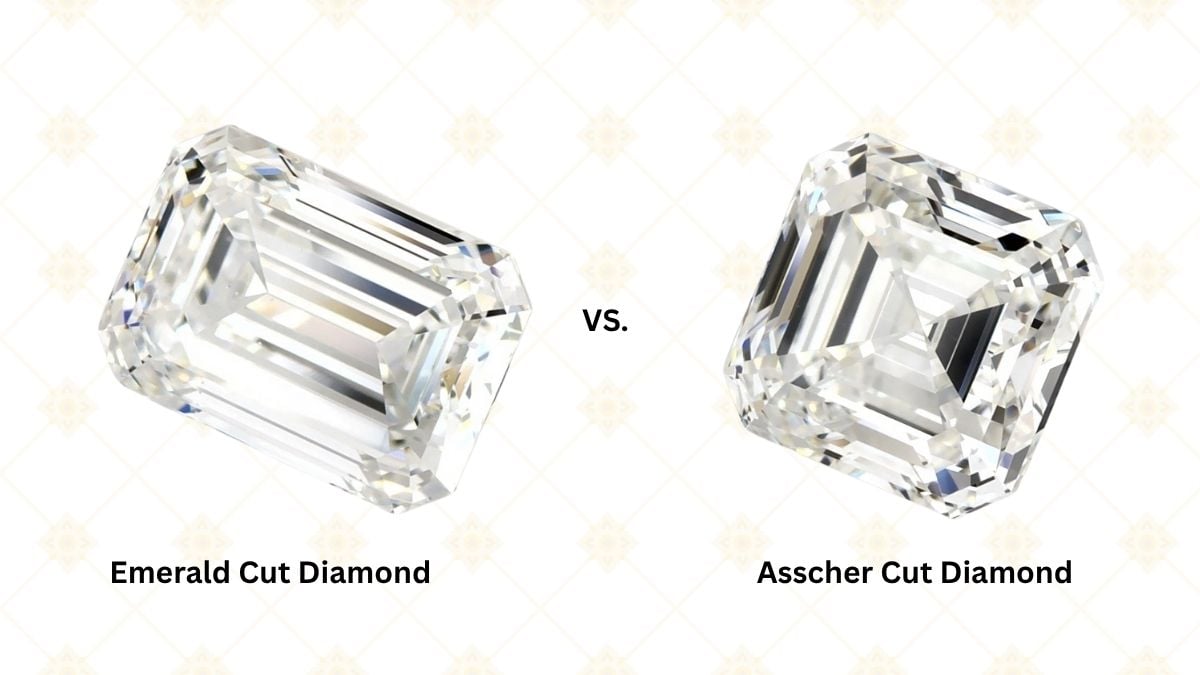
When comparing emerald cut diamonds vs. Asscher cut diamonds, there are many aspects to consider. We reached out to Afshin Shaddaie and here’s the points he said are most important to consider when comparing them.
- Brilliance and Fire
- Shape and Appearance on the Hand
- Clarity and Hiding Inclusions
- Price Comparison
1. Brilliance and Fire
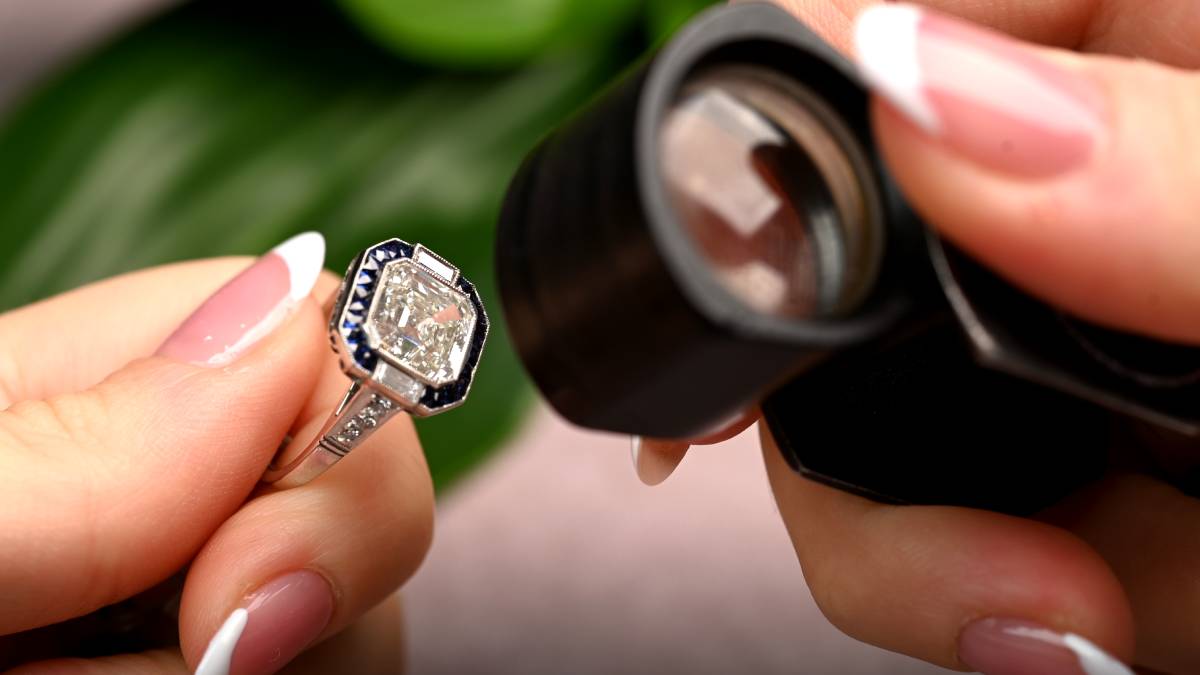
When comparing the sparkle of an emerald cut and an Asscher cut, it’s important to understand how their faceting influences light performance. Unlike brilliant cuts, which are designed for maximum sparkle, both the emerald and Asscher cuts belong to the step-cut family. This means they reflect light in broader, mirror-like flashes rather than the scattered sparkle seen in round or cushion-cut diamonds.
That said, there is a noticeable difference between the two. The emerald cut has long, parallel step facets that create a hall-of-mirrors effect, meaning light reflects in broad, elongated flashes. This effect emphasizes clarity and luster rather than intense brilliance. The emerald cut’s elongated shape also means light travels in straight lines rather than bouncing in multiple directions, making it appear more understated and elegant rather than fiery.
The Asscher cut, on the other hand, has a more kaleidoscopic light performance due to its square shape and concentric step-cut facets. Since it is cut deeper and has a higher crown, light gets trapped and reflected within the stone in a more dramatic way. This gives the Asscher cut a slightly brighter and livelier appearance compared to the emerald cut, though still far less than a brilliant cut diamond.
In summary: If subtle flashes of light appeal to you, the emerald cut is a perfect choice. However, if you want a step-cut diamond with more internal sparkle, the Asscher cut will provide more dazzle.
2. Shape and Appearance on the Hand

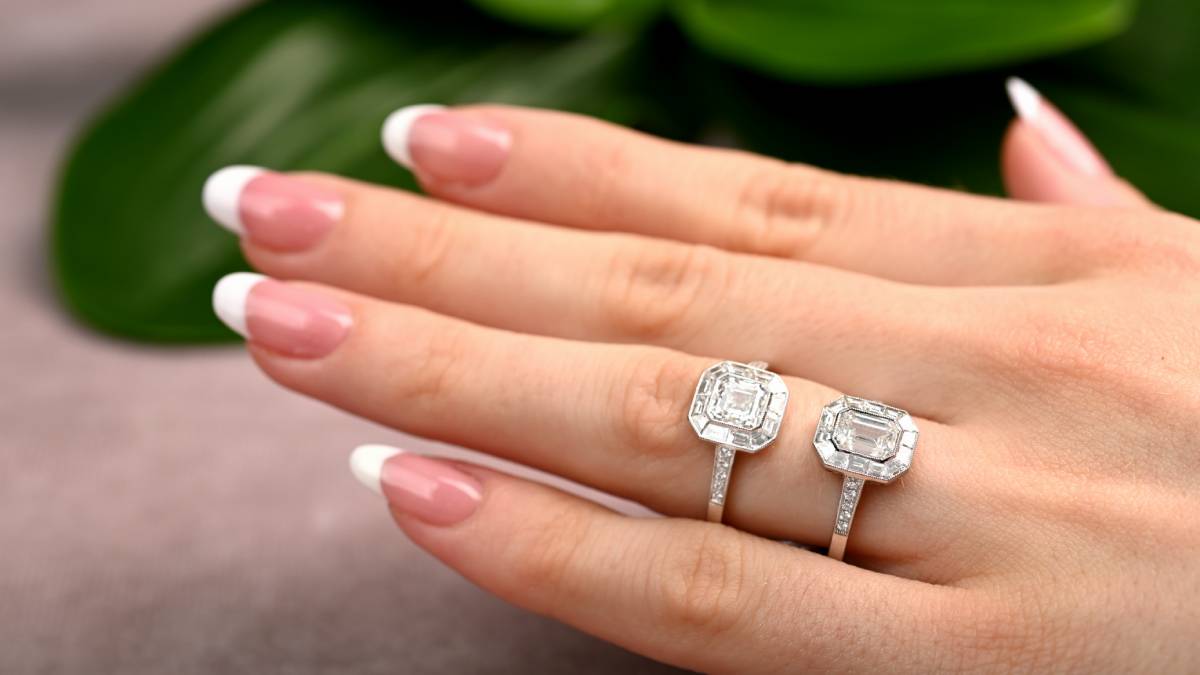
Being that the emerald cut and Asscher cut diamonds have very distinct shapes, the look very different when worn as a ring.
The emerald cut has a rectangular shape, which elongates the finger and creates a refined appearance. Because of its elongated shape, the emerald cut often appears larger per carat compared to the Asscher cut, making it an excellent choice for those who want a diamond that looks sizeable on the hand. This is one of the main reasons that celebrities love the emerald cut.
The Asscher cut, in contrast, has a square shape with cropped corners, forming an almost octagonal outline. This cut has a bold, geometric look with a strong Art Deco style. Due to its deeper proportions, the Asscher cut can appear slightly smaller than an emerald cut of the same carat weight, but it compensates with a mesmerizing, kaleidoscopic reflection pattern.
In summary: For those who prefer a sleek, elongating effect, the emerald cut is ideal. The Asscher cut is better suited for those who love a bold and symmetrical look with vintage charm.
3. Clarity and Hiding Inclusions
Both the emerald cut and Asscher cut diamonds have large facets, making clarity an important factor when choosing a stone. Unlike brilliant cuts, which have smaller facets (that help scatter light and mask inclusions), step-cut diamonds have much larger facets, making the internal flaws more visible.
Between the two, the Asscher cut does a slightly better job at concealing inclusions. Its deep pavilion create a kaleidoscopic effect, where light bounces inward and makes small inclusions less noticeable. However, this only provides a slight advantage, as larger (or central-located) inclusions will still be visible.
The emerald cut, with its long, straight facets and broad table, tends to make inclusions stand out more. Any imperfection beneath the surface is easier to detect. This means that higher clarity grades (VS2 or better) are generally recommended for emerald cuts to maintain a clean, flawless look.
In summary: If clarity is a top priority and both cuts should be chosen with minimal inclusions. However, if you want a step-cut diamond that is slightly more forgiving, the Asscher cut offers an advantage due to its shorter faceting pattern.
4. Price Comparison
When comparing the emerald cut against the Asscher cut in terms of price, the Asscher cut has a big advantage if you’re looking for a better deal.
Generally, Asscher cut diamonds tend to be slightly more affordable per carat than emerald cuts, especially in the larger carat ranges. This is primarily due to fact that there is a premium for elongated diamonds. And there is no such thing as an elongated Asscher cut.
Other than that one difference, the emerald cut and Asscher cut diamond will generally be the exact same price when comparing two diamonds of the same specifications.
In summary: The price between the emerald cut and Asscher cut are the same, aside for elongated emerald cuts which are far more expensive.
Shop Emerald Cut Rings and Asscher Cut Rings
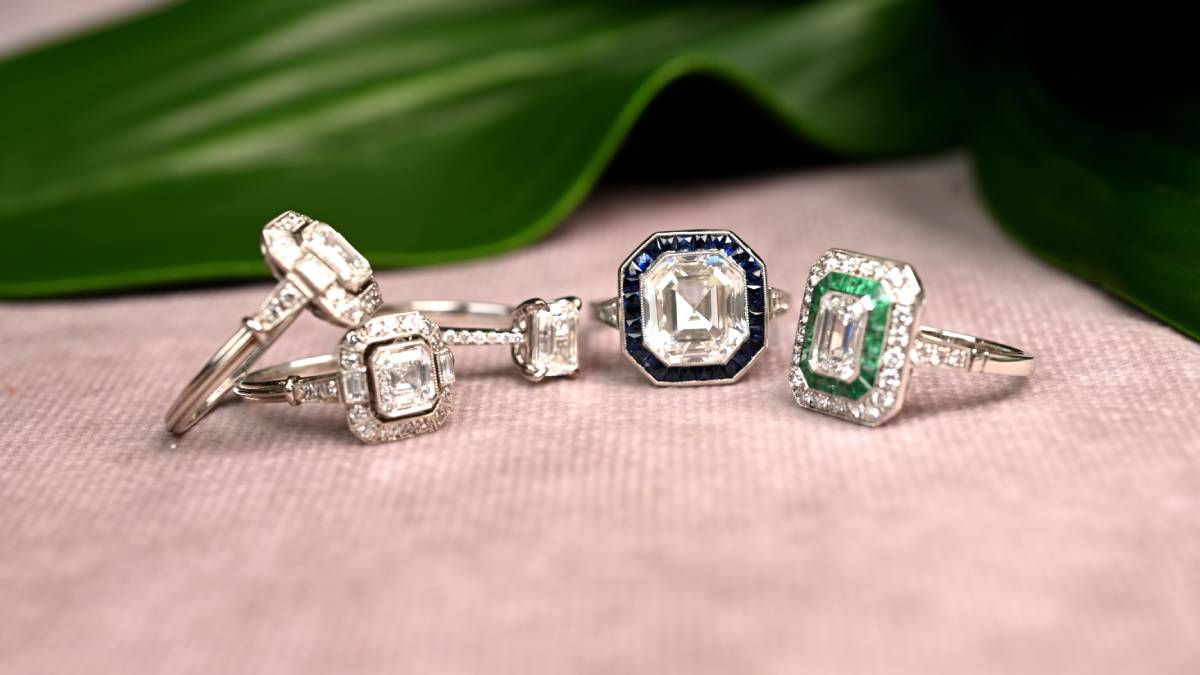
Shop our stunning collection of emerald cut diamond engagement rings and Asscher cut diamond engagement rings.
Frequently Asked Questions
1. Is an Asscher cut just a square emerald cut?
No, an Asscher cut is not simply a square emerald cut, even though both are step-cut diamonds with cropped corners. The Asscher cut has a deeper pavilion, a higher crown, and a distinctive “X” pattern that radiates from the corners toward the center, giving it a more kaleidoscopic look.
2. Which cut sparkles more: Emerald or Asscher?
Neither cut produces the same fiery sparkle as a round diamond, but between the two, the Asscher cut typically gives more visible reflection and light return. Its deeper proportions and square shape create a stronger “flash” in the center, especially under direct light.
3. Are emerald and Asscher cuts more expensive than other diamond shapes?
Generally speaking, emerald and Asscher cuts are among the more affordable among diamond shapes and are far more attainable than round diamonds or elongated shapes.
4. Is one cut more durable or practical for everyday wear?
Both cuts have trimmed corners that make them more secure than sharp-cornered shapes like princess cuts, but they still need to be properly protected with prongs or a bezel setting if you want complete protection. That being said, emerald cuts are slightly more practical for daily wear because their elongated shape spreads pressure more evenly.
5. What clarity and color grades are best for step-cut diamonds?
As mentioned in the article, emerald and Asscher cuts require higher clarity because their large open tables show inclusions very easily. For most buyers, a minimum of VS2 clarity is recommended, though collectors often choose VS1 or higher. In terms of color, these cuts tend to reveal warmth more than brilliant cuts. We recommend staying within the colorless to near-colorless range (D–I Colors).
6. Do these cuts work well with halos or three-stone settings?
Yes, emerald and Asscher cuts look stunning in halo and three-stone settings because their clean geometry pairs beautifully with symmetry. A halo can add extra sparkle and make the diamond appear larger, while three-stone settings frame the center stone and emphasize its shape. Emerald cuts pair well with trapezoids or tapered baguettes, while Asschers look brilliant with matching Asscher or baguette side stones to maintain balance and proportion.
7. Are emerald and Asscher cuts considered vintage or modern?
Both cuts are loved for their vintage charm but can also feel modern, depending on the setting. The Asscher cut is strongly associated with the Art Deco era. The emerald cut has roots in antique gemstone cutting but became iconic in modern culture thanks to Hollywood and celebrity engagement rings. In the right setting, either cut can lean vintage, contemporary, or a blend of both.
8. Do emerald or Asscher cuts go out of style?
Both of these shapes are considered timeless. Their elegance, symmetry, and historical roots mean they never truly go out of style, even when brilliant-cut shapes dominate trends.
9. Is it true that step-cut diamonds don’t sparkle as much as round or oval diamonds?
Yes, but this is by design, not a flaw. Step cuts like emerald and Asscher are cut for clarity and reflection, not for maximal sparkle. People who choose step cuts typically love their subtle elegance over intense brilliance.
10. Which finger shapes suit each cut best?
Emerald cuts are elongated and so are particularly flattering on longer or slender hands. Asscher cuts, being square, create a balanced and centered appearance, making them ideal for people with shorter or wider fingers who want symmetry rather than elongation.
Ultimately, though, both cuts can easily suit any hand shape.
11. Can emerald or Asscher cuts be set in an east-west orientation?
Emerald cuts can be beautifully set in an east-west orientation, creating a modern, horizontal look that feels sleek and fashion-forward. Asscher cuts, however, are square and symmetrical, so an east-west setting doesn’t change their appearance. They look the same in any direction.
12. Is it better to buy a lab-grown or natural emerald/Asscher cut diamond?
As we’ve mentioned in many articles, we strongly discourage buying lab-grown diamonds. Learn more about lab grown diamonds.
Talk to Diamond Expert
Do you have any questions about diamonds? Do you want to learn more about the difference between Emerald Cut vs. Asscher Cut Diamonds? Feel free to reach out to our diamond and jewelry experts. We will respond within one business hour.


