
Blog
Complete Buying Guide for Red Diamonds


Buying a red diamond requires careful research and expert guidance. In this article Afshin Shaddaie, one of the world’s leading authorities on rare diamonds and vintage jewelry, guides you on everything you need to know before buying this very-rare fancy diamond.
Shopping questions? Fill out the form below. We’ll respond within one business hour.
What Is a Red Diamond?
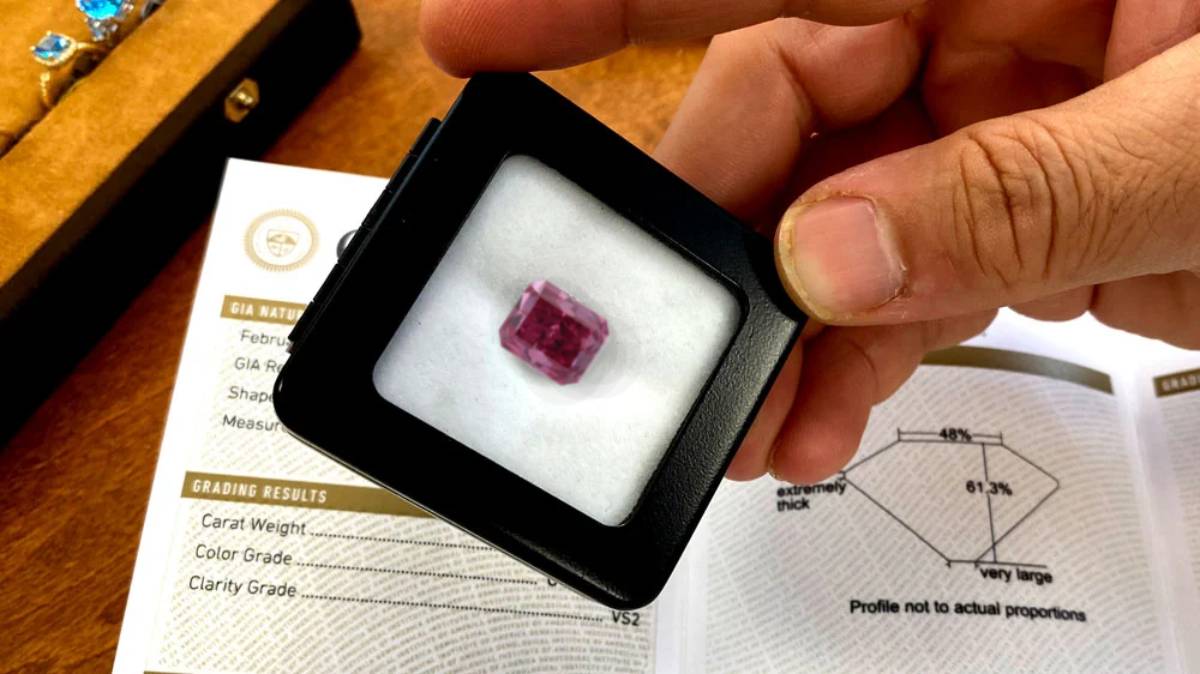
A red diamond is a natural diamond that displays a dominant red hue. In order to qualify as a red diamond, the color must be unmistakably red when viewed face-up (rather than a faint secondary red tint mixed into pink, brown, or purple). Additionally, it must be rare enough in both tone and saturation to be graded as red by an authoritative laboratory such as the GIA.
Unlike other colored diamonds that get their color from trace elements of nitrogen or boron, red diamonds owe their color to a rare distortion in their atomic structure. This internal distortion affects how light passes through the stone, creating the rich, deep red appearance. Red diamonds are considered the rarest of all natural diamond colors, with only a tiny number known to exist in gem-quality sizes.
How Much Does a Red Diamond Cost?
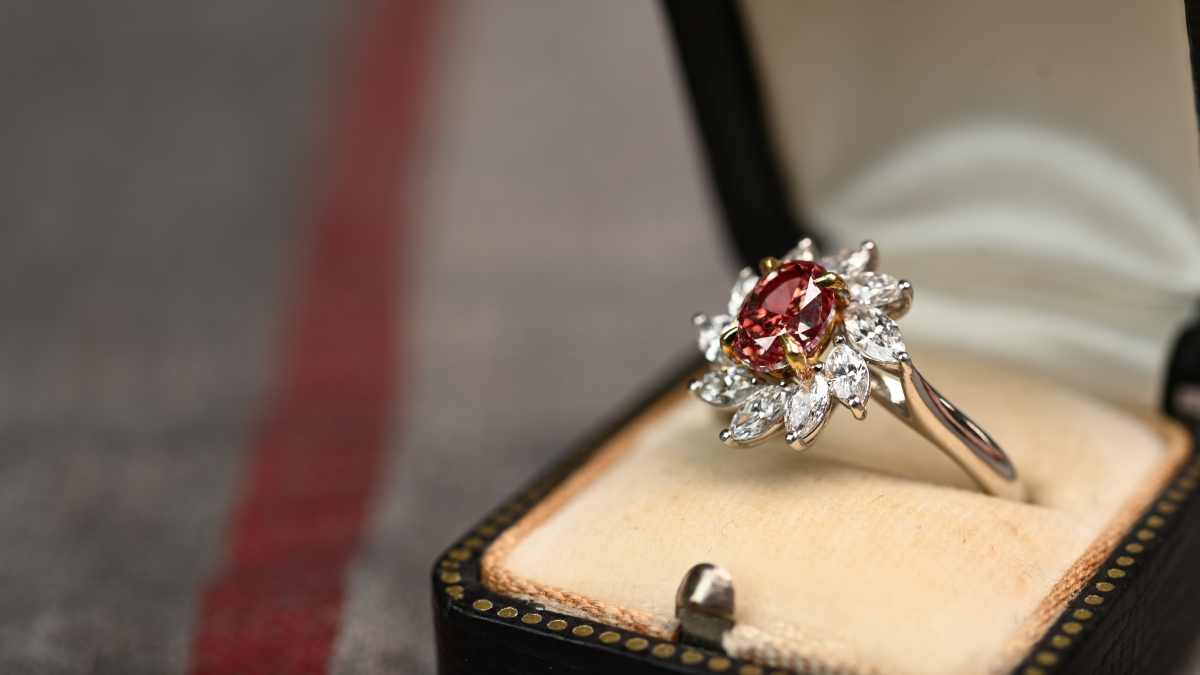
Red diamonds are among the most expensive gemstones in the world, with prices starting around $300,000 per carat for lower-quality red colored diamonds and easily reaching over $1 million per carat for the top-quality gems.
The exact price depends on several factors, including the intensity and purity of the red color, the spread, and the color of the secondary hues. Additionally the clarity, cut, and carat weight will play a big part of the price.
Since most red diamonds are under 0.50-carats, even the smallest stones can command six-figure prices. Larger stones, especially those with a strong color and excellent clarity, are incredibly rare. They usually sell at record-breaking prices in the high-end auctions or private sales.
Because there are so few red diamonds in circulation, and because demand among collectors remains high, it is very hard to know the exact price for red diamonds. Usually, one needs to reach out to exclusive colored diamond, and ask them what they have in stock, and how much it will cost. Most expert dealers won’t put their red-colored diamond inventory online.
Are Red Diamonds an Investment?
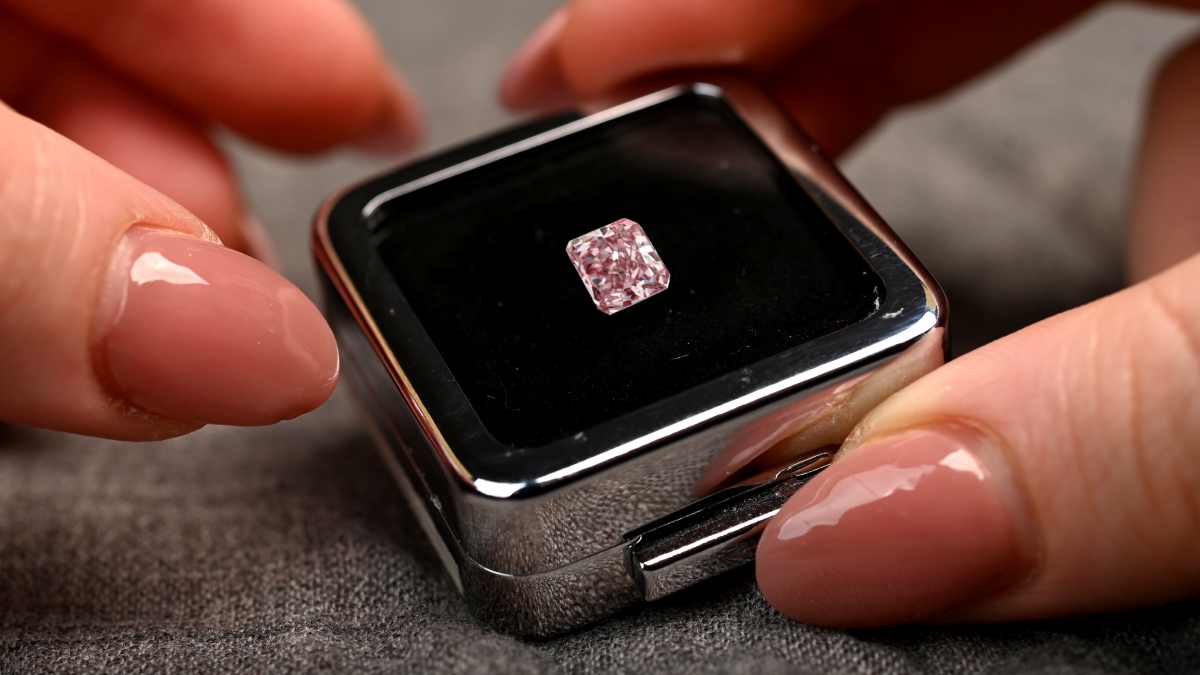
Red diamonds are usually considered by collectors to be one of the most high-performing investment-level gemstones in the world.
Their extreme rarity, combined with growing demand and extremely limited supply, has caused their value to increase rapidly over time. And unlike many other luxury assets, red diamonds rarely depreciate, especially when the stone has strong color and minimal secondary tones.
However, like any investment, success varies. We strongly recommend expert guidance with a purchase like this.
Click here to read our guide for this year on investment jewelry.
Advanced Guide for Buying a Red Diamond
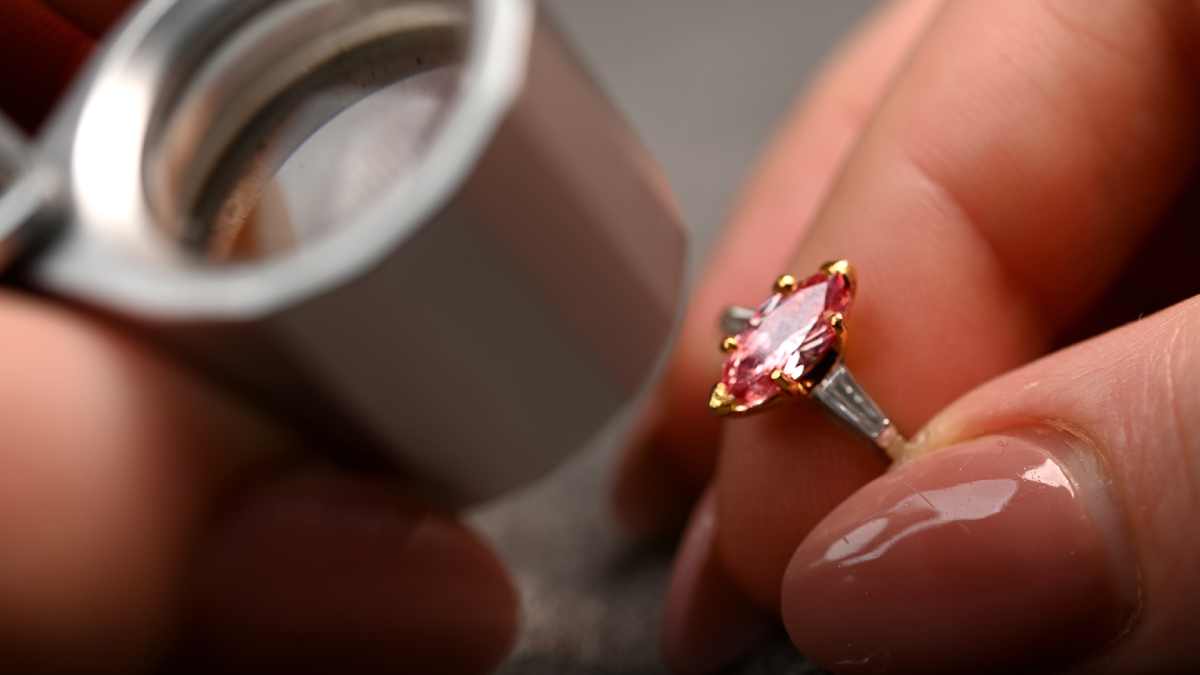
As with all jewelry purchases, there are a lot of moving pieces to understand regarding purchasing a red diamond. In this article, Benjamin Khordipour shares some of the most important aspects to understand.
1. Understanding Secondary Colors for Red Diamonds
In red diamonds, a secondary color is an additional modifying hue, such as purple, brown, or orange, that subtly blends with the dominant red and affects the diamond’s final color grade (for example, “purplish red” rather than pure “red”).
There are only a few gemstones in the world that have been graded as a red-colored diamond without also attaching a secondary color. It is for that reason that secondary colors is critical to understand in order to understand red diamonds.
Among the secondary hues, purplish red is usually the most desirable, as it adds richness without dulling the vibrancy. In contrast, brownish red diamonds are often less valuable, as the brown tint can mute the intensity of the red. GIA reports will always list these modifiers, so it’s essential to read the color grade carefully.
| Secondary Color | Description for GIA | Notes |
|---|---|---|
| None (Pure Red) | Fancy Red | Only a few examples in history |
| Purplish Red | Fancy Purplish Red | Considered by experts to be the most desirable secondary tone |
| Brownish Red | Fancy Brownish Red | Like all red diamonds, extremely rare |
| Orangy Red | Fancy Orangy Red | Like all red diamonds, extremely rare |
It is important to note that most respected and experienced collectors will only trust a GIA certificate when it comes to red diamonds.
2. Intensity Levels of Red Diamonds
Unlike other fancy colored diamonds, red diamonds are unique in that they are only graded with a single intensity level: Fancy. You won’t find terms like “Fancy Light Red” or “Fancy Vivid Red” on a GIA report for a red diamond. This is because the red hue is at the end of the saturation scale. Any diamond strong enough to qualify as red is already considered to have the highest possible intensity. Stones that don’t meet the threshold for Fancy Red will not be labeled as red.
3. Even Spread of Color
On a GIA colored diamond report, the “even spread” refers to how uniformly the diamond’s color is distributed across its face-up appearance, rather than appearing patchy, zoned, or concentrated in only certain areas.
GIA reports typically list color distribution as ‘Even,’ but in cases where the characteristic color does not clearly predominate face-up, GIA will describe the distribution as ‘Uneven’ on the laboratory report.
Although, this criteria is not as famous as many of the others listed in this article, the even spread is actually a very heavily weighted criteria. The spread of color will greatly impact the cost of the diamond.
4. Inclusions and Clarity Grade of Red Diamonds
Red diamonds are so unbelievably rare that most collectors are not overly concerned with the clarity grade so long as the inclusions aren’t jeopardizing the integrity of the gemstone. Additionally, because red diamonds form under intense plastic deformation in the crystal lattice, many contain internal features such as graining, stress patterns, and small feathers or crystals. In fact, it is common to see red diamonds selling with inclusions that fall within the SI and I categories.
Of course, it will impact the overall price, but not nearly as much as it will with other diamonds in the market.
5. Fluorescence in Red Diamonds
Fluorescence is the visible glow a diamond may emit under ultraviolet (UV) light. Usually, fluorescence is considered very undesirable, especially in collection-grade diamonds.
That being said, the GIA reports that fluorescence is very common in natural red diamonds. In its scientific study of the Winston Red, GIA found that the stone shows faint blue fluorescence under long-wave UV light, caused by the N3 defect, and noted that roughly 93% of Fancy red diamonds graded at GIA display similar blue fluorescence.
While rare cases of red fluorescence can occur due to nitrogen-vacancy centers, the typical fluorescence reaction in natural Fancy Reds is blue rather than red.
6. Red Diamonds from Argyle Mine
The Argyle Diamond Mine in Western Australia is the world’s primary source of pink, red, and violet diamonds. It is also considered among collectors to be the finest source for red diamonds. The mine’s closure in 2020 made natural red diamonds from the Argyle Mine even more exclusive.
If you’re buying a red diamond that comes from the Argyle Mine, it is critical that you have an authoritative certificate attesting to the mine location.
Alternatives Gemstones for Red Diamonds

Red diamonds are among the rarest gemstones on Earth (even in tiny sizes), which means that almost all buyers who love the red gemstone will usually have to explore more obtainable alternatives.
While no gemstone truly matches the extreme scarcity and prestige of a natural Fancy Red diamond, several other gems can offer a rich red color with their own beauty, history, and price advantages. The best choice depends on whether you value durability, long-term value retention, or simply achieving the most vivid red appearance in jewelry.
- Ruby: The classic red gemstone, prized for its richness, durability, and centuries of royal prestige.
- Red Spinel: Often mistaken for ruby historically, with vibrant red tones and excellent brilliance.
- Red Garnet: A widely available red stone, ranging from deep wine-red to bright crimson, often very affordable. Birthstone for January.
- Red Tourmaline (Rubellite): Known for its pinkish-red glow, especially in larger stones.
- Red Zircon: A natural gemstone with strong fire and brilliance, though softer than corundum.
- Red Diamond Simulants and Lab-Grown Stones: Visually similar options, but without the rarity or long-term collector value of a natural red diamond. We strongly discourage buying lab-grown diamonds.
Frequently Asked Questions

How rare is a natural red diamond?
Natural red diamonds are the rarest color of diamond ever documented, with only a handful of true Fancy Reds known worldwide. Their extreme scarcity is what places them in a category closer to museum gems than ordinary jewelry.
Are red diamonds more valuable than blue or pink diamonds?
In many cases, natural red diamonds command higher prices per carat than any other diamond color due to their unmatched rarity. Even small Fancy Reds can surpass the value of much larger pink or blue diamonds.
What clarity grades are most common in natural red diamonds?
Most natural red diamonds fall in the VS to SI clarity range, since the crystal deformation that produces red color often leaves internal strain features. Collectors typically prioritize color intensity far more than flawless clarity in this category.
Do red diamonds usually show fluorescence under UV light?
Yes. The GIA has found that the majority of Fancy red diamonds exhibit at least faint blue fluorescence under long-wave UV light. This reaction is a common identifying characteristic in many natural red diamonds.
How can you tell if a red diamond is natural or treated?
Because treated red diamonds exist in the market, confirming natural origin requires an authoritative laboratory report from GIA or a comparable institution. Subtle differences in color components and internal features are often only detectable through advanced testing.
Important Advice: Unless you see an authoritative certification (ideally from GIA), you cannot assume that a diamond is fancy red.
What are the most famous red diamonds in the world?
Notable examples include the Winston Red, the Hancock Red, and the Moussaieff Red Diamond, each representing a benchmark in rarity and color. These stones are widely cited because true Fancy Reds are so seldom available for public viewing or sale.
Talk to a Diamond Expert

Buying a red diamond requires expert guidance to avoid costly mistakes and ensure long-term value. Reach out to our team of seasoned jewelers. We respond within one business hour.


